Showing posts with label 1960s films. Show all posts

“How to Murder Your Wife” (1965): A Mixed Bag of Laughs and Cringe

Wednesday, October 1, 2025

Jack Lemmon shines as Stanley Ford, a lifelong bachelor cartoonist whose drunken antics and reluctant plunge into marriage drive this dark comedy. The film’s humor hinges on his physical comedy—think expanding waistlines from Italian cooking and lightbulb-electrocution mishaps. His habit of acting out comic strip scenes before drawing them adds genuine laughs, showcasing Lemmon’s genius.


The Good: Vintage Lemmon

  • Physical comedy gold: Slapstick moments (like the infamous lightbulb scene) highlight Lemmon’s talent.
  • Creative flair: Reenacting comic strip scenarios blurs fiction and reality in clever, absurd ways.
  • Charming chemistry: Virna Lisi’s character softens Stanley’s edges, offering glimmers of genuine connection.

The Dated: 1960s Gender Dynamics
The film’s “battle of the sexes” premise hasn’t aged well:

  • Misogyny as punchlines: Women are reduced to objects (bachelor parties turn wakes for “lost freedom”) or manipulators.
  • Marriage as imprisonment: The mustache-growing rebellion feels tragic, not funny, in today’s context.
  • Scantily clad stereotypes: Lisi’s wardrobe choices prioritize male gaze over character depth.

The Uncomfortable: Mutual Manipulation
Both genders weaponize distrust:

  • Stanley’s friends celebrate freedom when weddings collapse.
  • Wives use emotional blackmail (no motorcycles, no mustache, no independence).
  • The title’s dark premise—fantasizing spousal murder—feels jarringly mean-spirited.

Verdict: A Time Capsule, Not a Blueprint
While How to Murder Your Wife offers laughs through Lemmon’s brilliance, its gender politics clash with modern values. It’s best viewed as a cultural artifact—a reminder of how far we’ve come (and how far we still need to go) in portraying mutual respect in relationships.

Rating: ⭐️⭐️⭐️ (for Lemmon) / ⭐️ (for messaging) 

Read More

The Apartment (1960): A Lesson in Power Harassment

Thursday, January 12, 2023

The Apartment (1960)

starring Jack Lemmon, Shirley MacLaine, and Fred MacMurray


One of my favorite Christmas movies is actually a very depressing movie about power harassment and attempted suicide that happens to take place over Christmas. Weird, right?

There will be some spoilers, so keep that in mind when reading.

The Apartment was released in 1960 and stars Jack Lemmon as C.C. Baxter, Shirley MacLaine as Fran Kubelik, and Fred MacMurray as Mr. Sheldrake a.k.a the hound from hell. It is the brainchild of Billy Wilder (a favorite writer/director of mine) and I.A.L. Diamond and is brilliant and funny and horrifying all at the same time. Like a lot of those 1960s dramedies.

Power harassment is a manipulative tactic. If you go along to get along, you'll receive some benefit in return, or you'll just be able to keep your job. If you don't go along, then you'll lose your chances at promotion and possibly even lose your job. Not surprisingly, the term power harassment was originally coined in Japan, but not nearly as long ago as you might think, just in 2002. Japan has been and still is notorious for power harassment issues (like the majority of Asian countries), but based on the existence of movies like The Apartment, it is a wide-reaching demon that affects everyone.

Read More

The Delights of Doris Day in That Touch of Mink (1962)

Friday, April 3, 2020


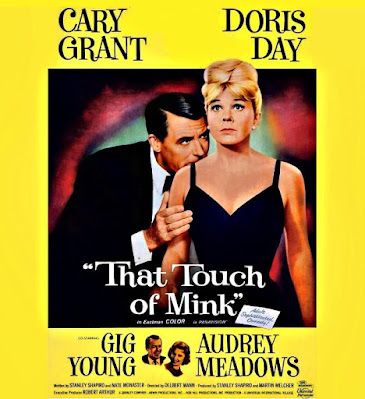
That Touch of Mink film poster


Well, here we go, it's time for The Fourth Doris Day Blogathon! If you are at all interested in reading other blog posts about Doris Day, then please do click on the blogathon links. There will be a ton of excellent content shared over the next couple of days.

I'm ashamed to admit that I've only seen a handful of her films, pretty much all of them from the 1960s, and I know almost nothing about her life other than she appeared absolutely charming. She has a warm, bubbly, spunky persona that always makes me smile, and she lives up to that reputation in That Touch of Mink, the film I chose to discuss for this fun blogathon.

The Fourth Doris Day Blogathon April 2020


Why That Touch of Mink, you might ask? Well, it costars Cary Grant for one thing despite what I will say about him later on, and it's a 1960s romantic comedy for another, and I LOVE the 1960s romantic comedies! There's a certain something about them that always entertain me. I think it's because they flirt with the dangerous side of romance more than the 40s and 50s (note that I did NOT mention the 30s since the 30s tended to get away with a LOT). But on the whole 1960s romances are more open about some previously taboo topics, and in my own quirky way, I love them. I could go on for days about Bob Hope comedies from the 1960s, but seeing as this is a Doris Day Blogathon, I'll refrain. 

Go to my Classic Hollywood page to find all my Classic Hollywood reviews!


Now, you may notice that I deliberately chose a different poster than the one usually associated with That Touch of Mink. This was purposeful because check out her eyes . . . rather like a frightened horse! 

And why should she be frightened you might ask? Well, we'll get into that in a minute.

But first, a summarization of That Touch of Mink told in screencaps.


Read More

A Grittier Side to Marlon Brando - The Night of the Following Day (1968)

Monday, May 2, 2016


The Night of the Following Day
R, 1968

An attractive teenage girl (Pamela Franklin) of a wealthy father (Hugues Wanner) is kidnapped on her way out of the airport by a man pretending to be a chauffeur, Bud, (Marlon Brando) and a guy who jumps into the car credited as Leer (Richard Boone). It turns out the blonde stewardess Vi (Rita Moreno) from the flight the girl was on is in on the job, as well as her brother, Wally (Jess Hahn).

A simple kidnapping for ransom rapidly escalates when Bud the chauffeur realizes that Leer is a sick, twisted S.O.B. with a taste for teenage girls. The stewardess, Vi, also Bud's girlfriend and Wally's sister, has a serious drug problem on top of Leer's fetish, and Bud wants out, and not just out, but to stop the whole thing and give the girl back. But this isn't the kind of story where everything goes the way you want it. At all.
Read More

How many times can you remake Little Miss Marker?!

Sunday, October 11, 2015


Please make sure to check out the They Remade What?! Blogathon.

It's a bit of a shock when you agree to something and then find out after the fact that your library only has 1 in 4 films. Not such a good thing. So I tracked down films 1, 2, and 3 on Amazon for a decent prize, made even more decent with rewards bucks through my credit card. One might call me obsessive and say I could have backed out of this topic, but I really didn't want to, and honestly, I was quite curious about Tony Curtis' film and Shirley Temple's. I only saw Shirley's movie once a long time back, and didn't care for it, so my memories were really sketchy, and my experience with Tony Curtis had been limited to his role in Walter Matthau's Little Miss Marker. How crazy is that, that the dude would get a role in the same movie twice!?

Anyway, I tracked all 4 films down, and did get them all watched, much to my relief and no small amount of pride.

For those of you unfamiliar with the story, let's start there.

Sorrowful Jones is a bookie, meaning he takes illegal bets on racehorses. On top of that, Sorrowful is a tightwad if ever there was one. Matthau's film even has the Tony Curtis character telling him that he knows Sorrowful still has the first dime he ever made, which might actually be true. One day, a desperate man walks into his establishment, wanting to place a bet with a marker, meaning a little slip of paper meaning he's good for the money. Sorowful doesn't take markers, but for whatever reason, in some he has a soft heart, in others he has an ulterior motive involving the winning horse, Sorrowful agrees to take the guy's marker. In this case, the marker is his little girl, whose name ranges all over the place. Sorrowful now has the little girl, daddy doesn't come back with the money, and Sorrowful is stuck with her. Softening of heart, protective fatherly instincts, and all of that, kick in, along with all sorts of emotional connection to the female lead, whose name also ranges all over the place.

The only really major variance in plot is the Tony Curtis film, 40 Pounds of Trouble, from 1962. This one is about a casino manager in Las Vegas named Steve McCluskey who's slightly on the lam from California so he can avoid paying alimony to his ex-wife. A guy in the casino loses a bundle, heads back to California to get it, never comes back, and good, old Steve realizes that the guy's daughter has been left behind.

Such are the plot main points.

Now, to examine the films under individual topics: Sorrowful Jones, The Kid/Doll/Marky/whatever, thoughts on the plot, and then my final thoughts.


Read More

Brando: A Countess from Hong Kong (1966)

Tuesday, June 4, 2013


Marlon, darling, dearest, I love you, but you have never been, will never be, a comedic actor. You are not Bob Hope or Bing Crosby, so falling flat on your face makes the audience rather wince instead of laugh.

With that made perfectly clear, A Countess from Hong Kong still manages to be pretty cute. Sophia Loren plays a woman whose parents were Russian nobility and fled to Hong Kong during the uprising when Czar Nicholas and his family were murdered. She was born in Hong Kong, but her parents died when she was only 13. Her life has been difficult and sordid. One night she is introduced to His Excellency Ogden Mears, the Ambassador to Saudi Arabia played by, you guessed it, Marlon Brando. After a wild night of partying, Ogden wakes up in his cruise cabin with a hangover and no memory of the voluptous Natascha who so impressed him the previous night. She minces out of the closet, and he nearly falls over the bed in shock. The ship has set sail, Natascha has no passport, and he has no way of easily keeping his reputation and still getting Natascha off the ship unseen.
Read More