Showing posts with label 1940s films. Show all posts

Movie Review: "Christmas Holiday" (1944) starring Deanna Durbin and Gene Kelly

Saturday, November 14, 2020

Christmas Holiday begins with Charles Mason (Dean Harens) just about ready to begin his holiday leave from the army. He's heading home to San Francisco to be married, but before he sets foot on the plane, he receives a telegram from his girl, telling him that she's terribly sorry but she's married someone else.

Despite the shock, Charles keeps his plans, boards the plane, and when foul weather arises, finds himself landed unexpectedly in New Orleans. A man he meets randomly invites him out to a nightclub where he meets singer Jackie Lamont (Deanna Durbin). Over the course of their brief encounter of a few days, Jackie tells him her story, that of a woman who fell in love with and married a liar and a prolific gambler, Robert Mannette (Gene Kelly). And, as it turns out, a murderer. When Robert is caught red-handed (almost literally), he is sentenced to prison. His mother, Mrs. Mannette (Gale Sondergaard), is deeply devoted to her son, and his arrest crushes the hopes she had that Robert might turn out all right since he married such a sweet, wholesome girl as Abigail (Jackie's real name). Instead, her fury turns against Abigail and before she can even blink, 7 years have passed and Abigail is now Jackie Lamont, a nightclub singer and about as far from that wholesome girl as she could get.

Go to my Classic Hollywood page to find all my Classic Hollywood reviews!


Deanna Durbin and Dean Harens

I see where Universal Pictures went wrong with this one. If you cast Deanna Durbin and Gene Kelly in a movie called Christmas Holiday, people will think that it's actually a fun, lively, breezy Christmas musical. You might just as well say that The Godfather is a Christmas movie.

To be fair, the novel's author W. Somerset Maugham entitled his 1939 novel the same title. But still, there were bound to be problems, first with the title, and then with the cast. It would have served them well to rename the film, giving Maugham the right to choose the name naturally, but to pick something else, anything else.

That said, for a 1940s noir film, it's not bad. There are a lot of dark, broody, dusky scenes, helped along by the black and white filming. I like how they added a bit of a New Orleans flavor to the set, especially the many levels of balconies so prevalent in that city.

Gene Kelly and Gale Sondergaard

You can tell where Gene Kelly is headed. He had only been in Hollywood for 2 years at this point, which I'm sure is why they cast the newcomer in such a different role than we usually associate with him. His character is charming, but he's a liar. He has the typical Kelly smile, but he's also somewhat terrifying. Let's just say it's not his normal fare which makes Christmas Holiday all the more interesting because it isn't how we're used to seeing Gene Kelly.

Deanna Durbin

As for Deanna Durbin, she's lovely, but she's dark. I didn't know she could play such a disillusioned character. One of my favorite scenes with her is actually when she begs Charles to take her to Christmas church services, where she sits weeping in one of the pews, grieving over what she has become and over what has been taken from her. She possessed genuine star quality in this film, something I didn't anticipate. She actually outshone Kelly, which is a hard thing to do, imo.

Dean Harens and Deanna Durbin

Then we have Dean Harens, an actor who was only cast in a couple of motion pictures and then moved over to television. He was a delight, handsome, good-natured, and sweet. I liked him immensely and I'm so terribly disappointed that he isn't in more movies.
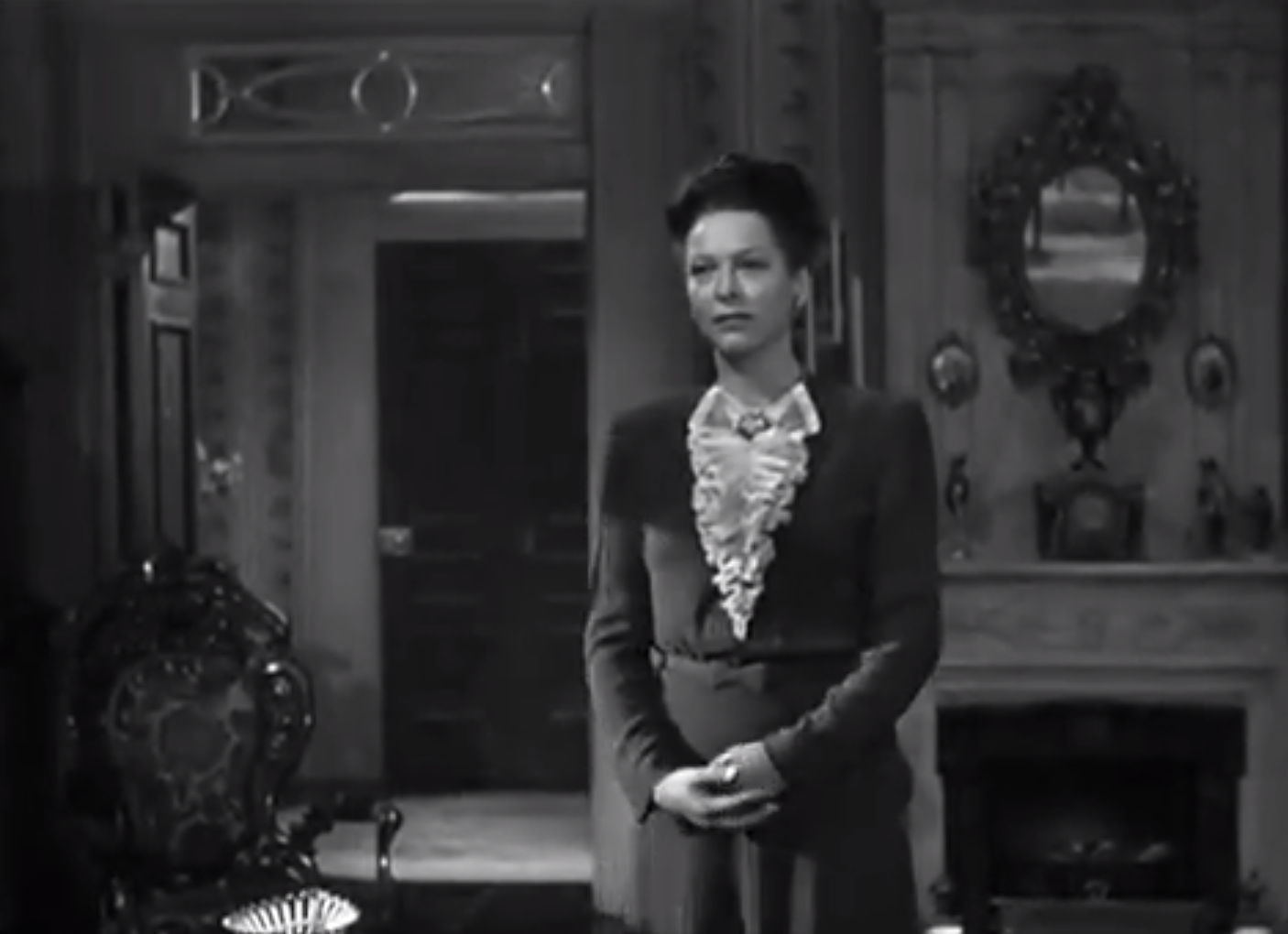
Gale Sondergaard

Gale Sondergaard as Manette's mother was a brilliant casting choice. She's always brilliant, but I appreciated her being not a straight-up villainess like we sometimes see. Here she's simply a mother who wants her son to be a better man.

Deanna Durbin and Gene Kelly

Did I love this movie? No, not really. I don't regret watching it, but sometimes the noir is just too broody if you know what I mean? A least the Hays Code kept Abigail from being a prostitute in a brothel, which is how the novel depicts her. So that's definitely on the plus side for me. It was more an interesting view of two actors whose usual roles are VERY different than their roles in Christmas Holiday. The ending is a bit of a humdinger so keep that in mind.

Deanna Durbin proclaimed this film to be her favorite role that she ever performed and I can see why. She does sing and here's where she sings Irving Berlin's Always, that beautiful song that most people probably associate with her. It's the theme song for Abigail and Robert's love and she sings it more than once, and it's just beautiful.

Deanna Durbin and Gene Kelly

If you want to try something different then Christmas Holiday might be right up your alley. Just remember, this is not an actual Christmas movie. It just happens to take place over the Christmas season, that's all. It could have been set at any time in the year and have been exactly the same story. This is film noir, plain and simple, and does a pretty decent job of depicting the genre.

Read More

Claude Rains, Ann Todd, and Trevor Howard in "The Passionate Friends" (1949)

Tuesday, November 10, 2020

I wrote this post for The Third Annual Claude Rains Blogathon hosted by PEPS.

Today is the first time I watched The Passionate Friends. I've never been a huge Claude Rains fan. He's been in the background of some of my favorite movies, but I never really paid him that much attention. I've done him an injustice all these years by not trying harder to find films featuring him in a more substantial role, and I owe him an apology.

Go to my Classic Hollywood page to find all my Classic Hollywood reviews!


The Passionate Friends involves a complex array of emotions that always come back to the same theme: fidelity or adultery. Happiness or sadness is not always something we can control, but a lot of the time, contentment is well within our control. It's something we either choose or don't choose.

Mary (Todd) is a very contented woman. Her compassionate husband, Howard (Rains) takes excellent care of her and gives her as much attention as he can for being such a busy man with his investments and his work. She likes her husband and he likes her, and if there isn't an enormous amount of passion, well, it is what Mary signed on for when she married Howard.

It's only when Steven (Howard), an old flame of hers, shows up that she's willing to risk it all. All of her contentment flies right out the window as soon as he walks in the door. Whether it's in 1939 when she embarked on her first affair with him or nearly 10 years later when they meet by chance while vacationing in the Alps (on the French side), Mary loses all sense of reason the moment she sees Steven.
Claude Rains and Ann Todd The Passionate Friends
Claude Rains and Ann Todd

This movie saddened me more than I can say, and I'm glad that it was made during the Hays Code since during that era infidelity if shown, had to have negative consequences. Which it always does, anyway, whether people realize it or not. Infidelity is going to hurt someone, deeply, be it children, relations, or one or the other of the spouses, particularly if both individuals are married, then there are two families who are being harmed.

Mary is a woman who likes to think of herself in a certain way. She's the narrator, and because she only sees things through her own lens, she's an unreliable narrator. There appears to be very little reason for her to love Steven over Howard. She appreciates Howard's steadiness, his support, and his affection for her, to say nothing of the wealth he provides. They're very well off. But Steven, well, he's the adventurous, romantic type who reads her poetry, dances with her, and whispers sweet nothings in her ear. She's in love with the idea of being in love, but not to the degree that she truly wants to sacrifice all of her comforts. She's a deeply selfish woman who only truly realizes her selfishness when she sees firsthand the pain she's causing Steven and his family.

Ann Todd and Trevor Howard in The Passionate Friends
Ann Todd and Trevor Howard
When Steven and Mary accidentally meet up ten years later, they go for a picnic in the Alps, have a couple of conversations, and that's it. Steven's happy with his wife and his children and as soon as he parts from his brief reunion with Mary, well, his thoughts are back with his family where they belong. But Mary cannot stand the idea of his happiness being something apart from her. She even imagines him telling her that he never got married because how could he marry anyone other than her. She deludes her so completely into thinking that Steven wants to be with her, that the harm done to Steven and his family is almost irreversible. Thank goodness I said almost because, naturally, there cannot be such a terribly tragic end.

Poor, dear Howard, Mary's husband. A lovely, quiet sort of man with very little visible passion, but at the end, after his first truly infuriated rant at his wife, Howard confesses his love for her. Because somewhere along the way, he truly fell in love with Mary, and he wants to keep her, warts, pains and all. 
Ann Todd and Trevor Howard in The Passionate Friends
Ann Todd and Trevor Howard

The ending had me holding my breath. I honestly wasn't sure what would happen. I won't go into details, but for me, it was highly satisfactory and showed the reality of forgiveness and mercy that can still exist in the world. People say things in anger and they're very true things, but it doesn't mean you can't find your way back from them. The relationship between Mary and Howard is actually a very beautiful thing.

Claude Rains is marvelous in The Passionate Friends. He doesn't have as many scenes as Ann Todd or Trevor Howard, but when he is on the screen, he's a scene-stealer. I appreciated his steady, smooth, professional approach, which made his rage near the end that much more terrifying. I've never seen him as a frightening sort of person, but he managed it there. I'm delighted to say that Claude Rains deeply impressed me and because I watched this film, I will seek out more of his movies.

Claude Rains and Ann Todd The Passionate Friends
Claude Rains and Ann Todd
Other reviewers have mentioned that Ann Todd felt distant in her role as Mary, that they could never fully connect with her, and I agree with them. But I think that's the point. Mary's fooled herself about herself so completely that the audience has no idea who she is. There is no genuine authenticity left in the woman, except perhaps at the very end, but even the ending is selfish on her part, though I'm sure she thinks herself selfless.

Then there's Trevor Howard. My goodness. I've only ever seen him in films from the 1960s so I could have never imagined him this young. I spent half the film disliking Steven, but at the same time, loving Trevor Howard's performance. It was a complicated viewing, to be sure. His character redeemed himself in my eyes because at their 10-year reunion, Steven would not cheat on his wife. And I appreciated seeing Trevor Howard play the character with fidelity at that point. It was refreshing after all of their shenanigans earlier in the film.

Overall, The Passionate Friends is thought-provoking and an overwhelmingly intimate look into the mind of Mary. I appreciate that they didn't take the story lightly or try to pretend that adultery is just a lark and harms nobody. I was surprised to learn that this was one of H. G. Wells' stories, but since I'm not keen on Wells, there's not much chance I would have ever read the story. I wonder if it's accurate. Anyway, David Lean as director delivered a stunning and mindful story that is brilliantly cast and I'm glad I took the time to watch it.

Remember, I wrote this post for The Third Annual Claude Rains Blogathon hosted by PEPS. When you get a chance, hop on over and read the other participants' posts.
Read More

Gene Kelly and Judy Garland shine in "The Pirate" (1948)

Thursday, November 5, 2020

I wrote this article for With Glamour and Panache: A Fred Astaire and Gene Kelly Musicals Blogathon hosted by Heidi at Along the Brandywine. 

Gene Kelly was one of my very first introductions to Classic Hollywood when I was a teen. I tried to get my hands on as many of his films as I possibly could, and probably watched at least 10 of his movies the first year I "found" him. Thank you, public library! 

I remember disliking his first pairing with Judy Garland, For Me and My Gal, and so I was reluctant to try The Pirate, but I am SO GLAD I DID. This has literally been one of my favorite Gene Kelly movies for at least two decades, although I do have a confession to make, which I'll get to later.

Go to my Classic Hollywood page to find all my Classic Hollywood reviews!

First, on to the story!

In the heart of the Spanish Main, young and sheltered Manuela (Judy Garland) dreams of adventure and romance. The pirate, Mack the Black Mococo, the scourge of the sea, is her ideal man, and she daydreams of him swooping down on her like a chickenhawk and carrying her away. Instead, she finds herself engaged to be married to the newly elected mayor Don Pedro Vargas (Walter Slezak) of their small town, a man at least twice her age and, if we may confess it, a bit on the soft and chubby side. An obedient girl, she acquiesces to the wishes of her Aunt Inez (Gladys Cooper) and agrees to the match. Not that she had much choice, but still, it's the thought that counts.

Manuela's single request now is that she be allowed to travel with her aunt to Port Sebastian to fetch her trousseau. Her desperation to see the ocean moves her aunt, and Inez agrees. After all, Inez will be with her, so what could possibly happen?

Apparently, lots and lots of things can happen!

Because at almost the exact same moment that Manuela and Inez pull into Port Sebastian so too arrives a troupe of performers, headed by the flamboyant and flirtatious Serafin (Gene Kelly, as if anyone else could play this role!). A ladies' man to the core, Serafin calls all the girls he meets niña, that is, until he bumps into Manuela. He falls for her in an instant (or as Michael Crawford says in Hello, Dolly!, "it only took a moment"). For her, well, it takes a bit longer because all she sees is a rake accosting her while she's simply standing by the railing admiring the sea.

That night, Manuela sneaks out to watch Serafin and his troupe perform. He spots her in the audience and brings out his mesmerizing mirror with he proceeds to hypnotize her. He thinks to get her to confess to her love for him (ummm, remember, they literally just met a few hours before so that's pretty ambitious of him). Instead, Manuela confesses her undying love for the pirate, Mack the Black Mococo, all while performing a sensual and intense dance number, of which she remembers nothing when she wakes up in Serafin's arms to him kissing her (snapping his fingers didn't work).

But an idea has been planted in Serafin's mind. Manuela refuses to love him as himself, but maybe, just maybe he can pull of the performance of a lifetime as Mack the Black Mococo. After all, she doesn't remember that she confessed her love for the pirate, and he's willing to try anything to win her. Can it work!?

This is a crazy movie, start to finish, no questions asked.

Judy Garland's costumes are stunning, absolutely marvelous and so vibrantly colorful. It would not have had the same effect in black and white. The Pirate absolutely REQUIRED technicolor. Gene Kelly never looked so suave and debonair. I usually don't go for the mustached man, but it so seriously worked for him in this film. He successfully channeled a bit of Tyronne Power and Douglas Fairbanks.

The music is upbeat and peppy thanks to the skills of Cole Porter, one of my favorite composers of Classic Hollywood. 

Now, on to my confession. Despite The Pirate being a musical, and my loving Cole Porter, the musical numbers are NOT my favorite thing because they just didn't FIT.

The musical numbers are a bit gaudy and ostentatious, if I'm to be honest, which sometimes works, but didn't quite do it for me here. Original audiences must have felt the same because The Pirate lost money at the box office. Gene Kelly's song Niña when he first arrives in Port Sebastian is fun, and matches the character, and it lets Kelly's dancing really shine. Unfortunately, the pirate ballet is a bit of a mess, an imaginary muddle that Manuela dreams up while watching Serafin playfully challenge a donkey with a sword. If you've spent your whole life wanting to see Kelly in shorts, then this is your musical number, me, not so much. And let's not forget Be a Clown. WHAT?! I mean, what . . . the . . . heck. I'm afraid that even Cole Porter ended up hating this film so something went sadly wrong somewhere on the musical side of things.

However, Love of My Life and You Can Do No Wrong play to Garland's strengths, lovely, sensual ballads meant to woo Serafin, and woo him she does. But I think the best is probably the main song Mack the Black, sung by Garland when her character is under Serafin's hypnosis. It's powerful and wild and allows Garland's chaotic energy to shine. Apparently, there was also a number filmed called Voodoo between Kelly and Garland. I'm thinking that Love of My Life took its place. Louis B. Mayer saw the footage of Voodoo, about had a heart attack, and demanded that even the negatives be burned. WOW, that must have been some number! Something like The Point of No Return in The Phantom of the Opera perhaps.

One of my favorite dance numbers, ironically, is one of the craziest but was also groundbreaking for the era. Dressed as clowns, Kelly dances with the Nicholas Brothers, two skilled African American dancers. Just watching that dance is incredible because it places all three men on equal footing. They wear the same costume and dance in sync with each other, with no one playing back-up. It's brilliant and makes The Pirate memorable for that reason alone.

Okay, I've mentioned that the musical numbers don't realllllly work for me. So you're probably wondering why I love this movie. It's because of Kelly and Garland, of course! Their chemistry is GENIOUS! 

There is pure snark radiating between them. I know Garland was struggling when making this film, but the audience would never know it. She sparkled like the richest ruby and Kelly in his masterful way brought just the right tinge of comedic humor to the role of Serafin. Vincente Minnelli did a terrific job directing this one, and I really do wish it had been more popular. I guess it was just a tad too silly, which I can understand, I do, but I still love it anyway.

I love the rip-roaring fight between Manuela and Serafin. It's HILARIOUS, I almost choke laughing every time I watch the movie. I especially love it because Garland actually hits Kelly a time or two when she's chucking brick-a-brack at him, to say nothing of swatting his behind with the flat of a fencing sword. It's the perfect comedic scene and from the very first time I watched The Pirate until now, for their chemistry alone, I love this movie.

The Pirate has a ridiculous ending and some ridiculous musical numbers, but Kelly and Garland are MAGIC.

Remember, I wrote this article for With Glamour and Panache: A Fred Astaire and Gene Kelly Musicals Blogathon hosted by Heidi at Along the Brandywine. So if you get a chance, head on over to her blog to read the other entries as they come trickling in over the next couple of days!

Read More

Cary Grant and Priscilla Lane star in the spooky spectacle "Arsenic and Old Lace" (1944)

Saturday, October 31, 2020

I wrote this for the Spooky Classic Movie Blogathon hosted by KN Winiarski Writes! 

For me, Halloween is synonymous with Arsenic and Old Lace. 

Every year I pull my copy off the shelf, blow an imaginary layer of dust from the cover, and pop it into the DVD player. I discovered this year that somehow we actually own 3 copies of this movie through a variety of giftings and inheritings from others. While I do love Arsenic and Old Lace, owning 3 copies is a bit much, even for me!

The art of dark comedy has always drawn me and you don't get much darker than this movie. There's a bit of a terrifying element underlying the whole thing for a variety of reasons.

But I'm getting ahead of myself.

Go to my Classic Hollywood page to find all my Classic Hollywood reviews!

Mortimer Brewster (Cary Grant), acclaimed dramatic critic and author, is in love. And for a man who has spent his entire adult life sarcastically decrying the idea of love and marriage, this is a stretch. But on Halloween, he finds himself and his darling bride-to-be, Elaine Harper (Priscilla Lane), standing in line at the marriage license bureau in Brooklyn, New York, getting officially hitched. He even has a honeymoon to Niagara Falls all planned, tickets for the train, and orders for flowers to be delivered to his new bride at her family's residence. Elaine's father is the local minister and the parsonage and the Brewster family home bookends a very historic, and slightly spooky cemetery. 

Everything is going so well! Mortimer and Elaine are married! His maiden aunts, Aunt Abby (Josephine Hull) and Aunt Martha (Jean Adair) are practically over the moon knowing their nephew has finally, finally proposed to the girl they've adored for so many years, and pretty much watched grow up next door. But alas, not everything is as it seems. Mortimer remembers that he left notes for his latest book Mind Over Matrimony somewhere in the house and he's desperate to find them before Elaine sees them. He hunts and hunts throughout the main room of the house, lifts up the window seat, and finds a dead body! Horror!

Not knowing quite how to approach his aunts with the devastating news that their other nephew Teddy (a dear man who unfortunately believes himself to be Teddy Roosevelt) has killed someone and put his body in the window seat. He approaches Abby and Martha as they're handing out goodies to the local trick-or-treaters (wow, I wish I got whole jack-o-lanterns and pumpkin pies when I trick-or-treated as a kid!).

Read More

Hedy Lamarr, Robert Walker, and June Allyson star in Her Highness and the Bellboy (1945)

Saturday, September 19, 2020

Her Highness and the Bellboy

Year: 1945 (set in 1938)

Starring: Hedy Lamarr, Robert Walker, June Allyson, Agnes Moorhead, and Rags Ragland

My Rating: ★★★★

Written for the Joe Pasternak Blogathon hosted by the Pure Entertainment Preservation Society.

Jimmy Dobson (Robert Walker) is a flirtatious bellboy for a fancy hotel but is, surprisingly, a bit of a straight-shooter. His closest friend is Albert Weever (Rags Ragland), another hotel employee, but one with a bit of an undescribed mental disability. Jimmy's fondness for Albert manifests whenever Albert starts getting dragged into bad company and Jimmy yanks him back out again. In a cozy old Victorian brownstone that has been split into multiple apartments, Jimmy lives fairly comfortably in an apartment directly below the lovely Leslie Odell (June Allyson), a charming and sweet girl who loves Jimmy dearly but suffers from emotional anxieties that manifest themselves in an inability to walk. So she spends her days painting Santa Claus figures to sell so she can help her aunt pay their rent and dreams of a day when Jimmy might just tell her he loves her back.

Go to my Classic Hollywood page to find all my Classic Hollywood reviews!

Each day is much like another for this little group of people until Princess Veronica (Hedy Lamarr) and her entourage including Countess Zoe (Agnes Moorhead) arrive from an unnamed European country. Princess Veronica wants to visit America for a very specific reason; she is in love with a newspaper journalist. But once there, a twist of fate throws the princess and Jimmy into the same path. Jimmy foolishly believes the princess is in love with him, when in reality, she yearns to marry her journalist who refuses her because he has no wish to marry royalty, no matter how much he loves her, which he does. Leslie yearns after Jimmy who is now infatuated with Princess Veronica who dearly dreams of her journalist. A mess if ever there was one.

At times a screwball comedy of errors, at times a romantic tragedy, Her Highness and the Bellboy is an entertaining ride from start to finish. 

Read More

Lucille Ball and John Hodiak star in Two Smart People (1946)

Friday, August 7, 2020

 
Two Smart People (1946) movie poster

Movie Review: Two Smart People (1946)


starring Lucille Ball, John Hodiak, and Lloyd Nolan

a blog post written for my We Love Lucy Blogathon

My Summary of Two Smart People


Two Smart People is what happens when two con artists try to pull a con on the same person and then manage to cheat each other of their mark. Ricki Woodner (Lucille Ball) and Ace Connors (John Hodiak) are quite a pair. Connors is on the run with stolen bonds glued into the binding of an ordinary cooking book while Ricki is always on the lookout for her next victim, yet somehow, fate has brought them together.

Fly Feletti, Connors' partner in the bond heist wants his share, but Connors isn't paying up, so as an old acquaintance of Ricki, he spills that Connors has a fortune in bonds stashed on him somewhere in the hopes that Ricki might be able to squeeze them out of him. Ricki pretends indifference, but in reality, she immediately sets Connors up as her new mark (just not partnered with Fly), a dangerous game to play with a man who's as equally clever as herself and can recognize when he's being played.
Read More

The Winsome Qualities of Greer Garson in the 1940 Pride and Prejudice

Monday, April 6, 2020

1940 Pride and Prejudice film poster

I was roughly 20-years-old when I first watched the 1940 version of Pride and Prejudice, which served a twofold purpose: beginning a life-long love affair with Laurence Olivier and launching me into a deep-rooted adoration for Greer Garson. My family gathered in the living room and I lay on a mound of blankets and pillows on the carpet, absolutely enthralled with this film. I'd never read Jane Austen until my later twenties, so I wasn't at all familiar with her stories. I guess you could say that Greer and Larry got me started down a more literary path of interest in my life!
Read More

Danny Kaye's cinematic debut in Up in Arms (1944)

Friday, July 29, 2016


Up in Arms (1944)
introducing Danny Kaye
and co-starring Dinah Shore, Dana Andrews, and Constance Dowling

I had a fairly decent sum saved up from my credit card rewards, and I couldn't think of a better way to spend it than on a Danny Kaye movie collection!

Apart from Bob Hope, Danny is my favorite funny man. But unlike Bob Hope who is sometimes too ridiculous, Danny always played lovable nut jobs with the right touch of realism to counteract the humor. I can't think of a single Danny Kaye role that I haven't loved so far. But the best thing about this collection is that I hadn't seen any of the 4 movies in it, one of which happens to be Danny's cinematic debut Up in Arms from 1944.

Danny Weems (Danny Kaye) is a lovable hypochondriac who took a job as an elevator man in a suite of doctor's offices just so he could be near medical care whenever he needed it. Patients get on his elevator and get off in worse shape than they were before. But Danny's lucky; he's got his best friend and roommate Joe (Dana Andrews) who supports him in all things. Except one. Joe falls in love with Mary (Constance Dowling), a lovely nurse from the building where Danny works. There's only one problem, Danny's convinced that he and Mary are in love and so he's blind to the growing attraction between Joe and Mary and blind to the romantic inclinations that Virginia (Dinah Shore), another nurse in the building, has towards him.

Everything might have continued in the same vein of awkwardness except that this is 1944 and so Danny and Joe get drafted into the military. And the girls, being the patriotic females that they are, also join up as nurses, the funny thing being that they're also higher ranked than Joe and Danny. Watching Danny, with his cases of medication, try to survive military life is hilarious, and it's a darn good thing that Joe is there to keep some of the thugs off his back. Resplendent with hilarious comedic gags, Up in Arms is a real winner up until the last 20 minutes and a terrific debut for Danny Kaye as a classic American funny man.

Despite it's winning qualities, though, I admit that there are some aspects that may offend modern viewers. Such as the Japanese soldiers at the end of the film that are just so dense I'm shocked they didn't walk off a cliff into the ocean. Danny manages to round all of them up with little trouble. They're caricatures of the Japanese and I caught myself wincing several times.

I'm also not sure about that bizarre dream sequence, also near the end, that merely seemed an excuse to roll out the Goldwyn Girls with their sparkling smiles and gorgeous figures. It felt like that absurd sequence out of Singin' in the Rain which makes sense since the movies were made in the same decade. One of those Goldwyn Girls happened to be Virginia Mayo, the girl who played opposite Danny in 4 pictures including The Secret Life of Walter Mitty (review upcoming at some point), so that bit was fun. But I'm still glad they cast Constance Dowling as Mary since I feel she had the right mixture of loveliness and compassion.

If you don't mind the little oddities, you'll love Up in Arms. It's nowhere near as offensive as the Bing Crosby black face number in Holiday Inn, a movie I LOVE all except for that one musical number. ❤


This poor man's first encounter with Danny leaves him far sicker than he ever was before he stepped into that elevator, much to the fury of the man's doctor.


The lovely Dinah Shore as Virginia, the girl who secretly loves Danny and who was just his practice model for a marriage proposal to Mary. No wonder she's mad.


Danny's first musical number in the film, while waiting for a motion picture to start. He effectively mocked going to the movies in a healthy dose of irony.


And here you have buddy Joe (Dana Andrews) and Danny's flame Mary (Constance Dowling) making eyes after a double-date. Poor Danny, so clueless, especially since Mary never actually led him on. He can't tell when a girl's just being nice.


Danny getting the infamous news that he's been DRAFTED!


While out with the boys and Mary, Virginia sings into a record recorder while a horde of soldiers gather. It's Now I Know and one of those typical songs during the World War II era that just gets you.


In a fit of insanity, Danny smuggles Mary onto the boat by accident just as it ships out, leaving Joe to help Danny figure out how to hide her.


And one last screen cap just for fun. Chaos is about to ensue in this one, in case you couldn't tell. Oh, and Mary's hiding under the bunk.
Read More

Movie Review: The Harvey Girls (1946) starring Judy Garland and John Hodiak

Monday, July 25, 2016


The Harvey Girls (1946)
starring Judy Garland, John Hodiak, and Angela Lansbury
co-starring Ray Bolger, Marjorie Main, Chill Wills, Kenny Baker, and Cyd Charisse

I remember LOVING The Harvey Girls the first time I saw it, so naturally I was curious to see if that emotion had staying power since I hadn't seen the movie in over a decade. As it happens, yes, I still love it, and with good reason.

I've never minded mail-order bride stories, and that's how this one begins, with young Susan Bradley (Judy Garland) headed west to marry a man who she's only corresponded with, but never met. Full of hope and light, a tad bit hungry, she encounters a group of young women also headed west, known as the Harvey Girls. They are employed by Fred Harvey to open a Harvey House restaurant that brings culture and refinement to western towns. Enthralled with the young ladies in this group, Susan immediately befriends them, especially since her stop and theirs is the same one.
Read More

Movie Review: Unfaithfully Yours (1948)

Tuesday, July 12, 2016


Unfaithfully Yours (1948)
starring Rex Harrison and Linda Darnell
supporting cast: Rudy Vallee, Barbara Lawrence, and Lionel Stander

Have you ever had a single performance color every other movie an actor makes? Welcome to my experience with Rex Harrison. Every movie he made is colored for me by Henry Higgins from My Fair Lady. For some people this might not be such a bad thing, but for me . . . well, I don't like Henry Higgins all that much so I struggle with liking Rex Harrison by default.

HOWEVER, that said, it's almost impossible to dislike a Preston Sturges film since the man was brilliant and Unfaithfully Yours didn't make it into the Criterion Collection without a good reason. Black comedies have their place and this is one of the best, easily ranked up there with Arsenic and Old Lace and The Ladykillers.


Welcome to the story of a man who learns the hard way that lack of sleep and self-imposed starvation result in PARANOIA. Get your 8 hours and eat a healthy diet of calories and you'll likely NOT jump to the same wacky conclusions as our hero, Sir Alfred de Carter (Rex Harrison).

Alfred and his youthful bride Daphne (Linda Darnell) are absolutely drippy with romantic affection for one another. It's almost sickening. But all that changes when Alfred returns from a trip to find that his brother-in-law August Henshler (Rudy Vallee) has had a private detective follow Daphne, completely misconstruing Alfred's request for August to keep an eye on her while he was gone. Being the temperamental artist that he is (he's a maestro for an orchestra), Alfred throws August out on his rear, but the seeds have been planted. It takes only a little sprinkling of water here and there for him to think that Daphne and his young, handsome secretary Anthony Windborn (Kurt Kreuger) are having a riotous love affair. After all, Anthony is much nearer to Daphne's own age than Alfred.

Short on sleep and those calories we talked about, during one of his concerts, his mind wanders down the rabbit hole, imagining all sorts of crazy scenarios that include an elaborate scheme involving a voice recorder and a scene like something out of a slasher flick sans blood, then a scene where he's all forgiving and writes her a check and gives her permission to leave him, and finally a scene where he challenges Anthony to a game of Russian roulette . . . and loses.

Of course, those scenarios are all merely figments of his imagination. Real life is much more fun with its insanity and quirks as he makes foolish attempts at all three before finally realizing his wife is INNOCENT of all wrongdoing and he's been an idiot. Happy ending!


And the only reason why I'm telling everyone a few details about what happens is so you'll actually watch it. Here's where Unfaithfully Yours differs from other black comedies. Nobody actually dies, unlike Arsenic and Old Lace and The Ladykillers. So it's a much more lighthearted experience despite its blackness. Sadly, that very blackness kept this film from being a rousing success upon its debut, but critical response was favorable. I guess it was just slightly too dark for 1940s audiences, a would-be murderer as the main character and all. Never mind that he's a goof and a bungler.

Kudos, once again, to Preston Sturges, this time for the deliciously witty dialogue that is so redolent throughout the film. That man knew how to write dialogue. I drool with envy. And here's where I must also congratulate Rex Harrison. Now that I've seen Unfaithfully Yours at least twice, I can honestly praise him and freely admit that I don't believe anyone else could have played the role with quite so much sarcastic humor and wit. Possibly the only other fit might have been Laurence Olivier, but I believe Olivier was doing Hamlet in 1948 so he was just a tad busy.


As for Linda Darnell, she's such a lovely woman, and while I do feel she overdid it a little bit with her "I'm insanely in love with my husband" routine, she matched Rex Harrison beautifully. Although I do wish she'd pouted less while whispering sweet nothings in his ear. Reminded me far too much of Marilyn Monroe's propensity to do that pooch thing with her lips, which I never found attractive. It was fun watching her play opposite Rex Harrison in his imaginary scenes, and her character in real life is genuinely in love with her husband and has never, would never, cheat on him, so that made her instantly likeable.


Welcome Rudy Vallee and Barbara Lawrence, both stars in their own right. It's always fun when Rudy Vallee pops up in film. I know him mostly as a singer and as a poor, hapless guest star on I Love Lucy. Poor, poor man. And here he gets his jacket torn practically to ribbons by Rex Harrison. Gotta love it! Barbara Lawrence plays Rudy's unhappily married wife, and no wonder since they are so very poorly matched. But I know I've seen her in other films and she always spices things up a bit.


Some days you just need a good black comedy. Those are the days when I'll pluck The Ladykillers off my shelf and indulge in countless belly laughs, and now I have another film to add to my collection.
❤

Particularly Funny Bits

"Well, August, what happy updraft wafts you hither?" - Alfred

"I give you my solemn word, August: if I don't regain control of myself in a few minutes, concert or no concert, I'll take this candelabrum and beat that walnut you use for a head into a nutburger, I believe they're called!"- Alfred

"People said "What do you wanna hear that Limey for? What does he know about music? It takes an Eye-talian, a Russian or a Dutchman to bring it out good," but something inside of me said "Give the Limey a chance!" And I did! And am I glad I did!" - Detective Sweeney

"There's nothing wrong with me that a couple of magnums of Champagne won't cure!" - Alfred
Read More

Movie Review: The Two Mrs. Carrolls (1947)

Sunday, July 10, 2016


The Two Mrs. Carrolls (1947)
starring Humphrey Bogart and Barbara Stanwyck
supporting cast: Alexis Smith and Nigel Bruce

Why in the world are movies like Gaslight, Dial M for Murder, and Midnight Lace so insanely popular? I guess audiences just love to see men plotting to kill their wives, either out of some crazed need for control or simply because they are crazy.

In that vein, the plot for The Two Mrs. Carrolls is really nothing new.


Humphrey Bogart plays a starving artist type of character named Geoffrey Carroll whose wife always serves as his muse. At least until he tires of her, bumps her off kindly with poison, and marries the next in line. Talk about a vicious cycle, and who should get caught up in it but Barbara Stanwyck as the next wife in line, one Sally Morton Carroll. A charming, naive young woman, Sally adores her new husband and his little 10-year-old daughter. She supports Geoffrey in all he does, and things go along cheerfully for awhile in what is known as the honeymoon stage. That is until his inspiration starts to fade, his irritation peaks, and the gal down the street, Cecily Latham (played by Alexis Smith) insists he paint her portrait. Now Geoffrey has his eye on the next Mrs. Carroll and its time to bring out that old bottle of poison again. The bumbling town doctor played by none other than Nigel Bruce (wow, did he lose some weight!) thinks Sally's illness is just an attack of nerves, but pieces start to fall into place and Sally begins to see her beloved husband in a new, and far more suspicious, light. The question is, can she gain back her strength and energy before it's too late? Perhaps not ever her ex-fiance Charles Pennington (Patrick O'Moore), who she calls Penny, can get to her in time.
Read More

Movie Review: In the Good Old Summertime (1949)

Thursday, July 7, 2016


In the Good Old Summertime (1947)
starring Judy Garland and Van Johnson

And here is the 1st remake of The Shop Around the Corner (my review here)!

Once, many, many moons ago when I was quite young, I did watch In the Good Old Summertime and I remember not liking it, but also, I remember not having the intellectual development to discern my exact reasoning.

To be fair, it's a tough act to follow Jimmy Stewart. I wouldn't want to do it, ever, and I don't envy Van Johnson for having to make the attempt. So, I'll try to be kind about what didn't work and be honest about what did work for me.

First, I'm a little shocked at how very close of a remake this is to the original; it has a lot of the same dialogue. I'm not sure what was wrong with the idea of placing the remake in 1949 when it was made, but they chose to plop it into the turn of the century instead, which almost worked, but not quite. More on that later.

The basics of the plot are these: still a little shop, still handwritten letters signed "Dear Friend," still a guy and a gal who can't stand each other in real life, but are writing those letters in private. The differences are that the shop is not in Budapest but Chicago, it's not 1940 but 1900, and the shop owner's wife is not having an affair because he isn't even married yet.

Van Johnson plays Andrew Larkin and Judy Garland plays Veronica Fisher.


Next, I love Judy Garland, and I love Van Johnson. But not together. Judy possessed such an intense film presence that she required a leading man who could stand up to her vivacity. Van Johnson is NOT that man, I'm sorry to say. MGM would have been better served to have either used Judy and a different leading man or Van and a different leading lady. Because a different pairing either way would have worked. The two just don't mesh well, and I was never convinced that they could possibly fall in love.

It's hard to love a guy who brings Judy to tears. Jimmy Stewart managed to be gruff, but still lovable. Van just ended up off-putting in his scenes with Judy, poor guy. Again, with the not envying him having to remake a Jimmy Stewart classic.

Now for costuming. This is the turn of the century, as in 1900, as in still mostly Victorian. What happened with the costuming for In the Good Old Summertime?! Judy wears skirts that are mid-calf and flowing a lot of the time whereas the women around her have skirts to their ankles. The best and most accurate gown she ever wore was at the very beginning in what was probably the best scene where Van Johnson trips her and proceeds to accidentally destroy her hat, parasol, and ends taking her skirt with him . . . caught in the wheel of his bicycle. It's a hilarious scene and the outfit was Victorian.


Then you have this gown. It's a 1949 red special, honestly, with a full, flowing skirt that only goes mid-calf and would have been absolutely SCANDALOUS at a party in 1900. My goodness, how she would have been shunned for wearing that get-up. It's lovely, don't get me wrong, but in completely the wrong setting.

One of the things that did really work was the casting of Spring Byington and S. Z. Sakall as Nellie and Otto Oberkugen (the owner of the music shop where Veronica and Andy are employed). They added a charmed element to the film that I hadn't anticipated and I ended up investing more in their romantic relationship that had developed over 20 years than I was in the biting, cross give-and-take between Andy and Veronica.

Also, who should show up but Buster Keaton. My only experience with the man is Benny and Joon where Johnny Depp's character styles himself after Buster. So I didn't even know Buster was in this film until the credits came on the screen. He's goofy, crazy, and he planned out the slapstick bits in the film. I guess you could say that he added a bit of levity.


Now comes my question of why a musical?

I don't mind musicals, but I honestly felt that the singing detracted from the plot with this one. On the plus side the singing mostly had to do with Veronica's job, working in a music store and all that, but I do believe that more could have been done without all that singing. And why have Judy sing 2 songs at Otto and Nellie's engagement party? Still, that's my personal preference and nothing more.

I really think In the Good Old Summertime would have been adorable . . . had it been set in 1949. In fact, I would have LOVED seeing it set in the era in which it was filmed. There's even a good chance that Judy and Van might have worked up better romantic synergy had the era been different. As it was, you have him, a traditional fuddy duddy of 1900, and her, a woman who sings "I Don't Care" at the top of her lungs at an engagement party. I realllllly don't see that ever working.

Still, this film was considered a massive box office success by MGM. Fans loved it. This was the era of the nonsensical musical like Singin' in the Rain and others of its ilk, so I can't expect In the Good Old Summertime to be anything different. But it was a bizarre reminder to me why I prefer movies made between 1930 and 1945.

In the end, In the Good Old Summertime doesn't live up to its predecessor, The Shop Around the Corner. But I can still see why people love it.

Although, can anyone tell me why they spend 70% of the film in winter and the movie is called In the Good Old Summertime? I'm pretty sure they could have chosen a different song for the title of the movie!

If you do give it a look-see, isn't little Liza Minnelli ADORABLE at the end (not that the scene advances the plot in any way, but still)? ❤
Read More

Movie Review: The Shop Around the Corner (1940)

Monday, July 4, 2016


The Shop Around the Corner (1940)
starring James Stewart and Margaret Sullavan
supporting cast: Frank Morgan

In a fit of boredom, I've begun watching classic films again. I was just fortunate enough to find a James Stewart collection of movies during one of my last trips to the store and it just happened to include The Shop Around the Corner. I vaguely remembered this little title from several years ago,but nothing really stood out to me. So I decided to pay $2.50 for it so I could watch it again, without suffering through the bother of a scratched library disc. Talk about a great purchase!

For fans of classic cinema, The Shop Around the Corner is also known as being the 1st in a line of remakes: In the Good Old Summertime (1949) starring Van Johnson and Judy Garland and, of course, You've Got Mail (1998) starring Tom Hanks and Meg Ryan.


Based on a Hungarian theatrical play from 1937, The Shop Around the Corner takes place in Budapest and, remarkably, has nothing to do with World War II. Instead, it follows the love lives of two shop employees, Alfred Kralik (James Stewart) and Klara Novak (Margaret Sullavan). Each of them has been a letter correspondent to an individual who placed an advertisement in the newspaper desiring to correspond about social, literary, and intellectual interests. Naturally, the two are corresponding with one another! A fact made more amusing because in real life they're coworkers and can't stand each other!

The supporting cast includes: Frank Morgan (The Wizard of Oz), Felix Bressart, Joseph Schildkraut, William Tracy, and Sara Haden. A fine collection of actors offering both additional comic relief and serious drama and the reality of pain involved with infidelity.


There's something so utterly romantic about true love developing through letters. There is so much power in the written word. So much potential to share an intimate part of oneself so completely that the other person knows you fully. That is the love story in The Shop Around the Corner. Alfred and Klara dislike one another, sort of, in the real world, but that's only because the intimacy they've shared on the written page is not the same sort of intimacy one shares in the everyday, with coworkers and acquaintances. It's no wonder that neither of them suspected the other was their letter correspondent. In the day-to-day encounters, all they saw was the external while the letters allowed a glimpse of the internal. Two entirely different things.


Every once in awhile, classic Hollywood really delivered a winner . . . like The Shop Around the Corner. If you're at all familiar with James Stewart than you know he thrives on sharp, snappy dialogue. After all, he was my favorite part of The Philadelphia Story. So if there's one thing Samson Raphaelson is able to deliver it's that snappy dialogue associated with sophisticated romantic comedies of the eras. The pairing of Raphaelson' script and Stewart's acting is supremely brilliant. Frank Morgan remains a long-time favorite of mine, every since I saw him as the wizard in The Wizard of Oz. As for Margaret Sullavan, I've never seen her in any other role, but I liked her performance well enough that I want to test some of her other roles.


I honestly couldn't tell you why I didn't care for The Shop Around the Corner the first time I saw it, but I can say that I love it now. It's one of the most vibrant and delightful films of that transitional period between the 1930s and 1940s, a gem delivered by director Ernst Lubitsch.

While I already know this version is my favorite of the 3 films made from this story, I'll be watching In the Good Old Summertime and You've Got Mail sometime in the next couple of months, so stay tuned.

And if you've never seen The Shop Around the Corner, there's no time like the present! ❤ 
Read More