Showing posts with label the classics club. Show all posts

First Classics Club Read of 2023 - Pride and Prejudice (1813) by Jane Austen

Thursday, February 9, 2023

I'm sitting at my laptop with my cup of delicious Blackcurrent Breeze tea from Twinings and my fingers freezing due to the dip in temperatures outside. I am so immensely grateful today. I'm grateful for my cup of tea. For my space heater that is working its little tail off to warm my home office space. For my cozy slippers and wool socks. And I'm grateful for Jane Austen.

I first encountered Austen probably 19 or so years ago now. My father is a huge Laurence Olivier fan, so when I was in my late teens, we watched the 1940 Pride and Prejudice as a family, with Olivier in the starring role as Mr. Darcy, naturally (read my review, if you wish). It's still my favorite film adaptation, despite its historic and literary inaccuracies.

But I hadn't picked up Pride and Prejudice to read until at least a decade later. And it certainly wasn't my favorite of Austen's novels. I always thought my dislike is because I'm quite stubborn about joining a fandom with a high rate of support.

I'm not sure what's changed in 2023, but something clearly has because I loved re-reading Pride and Prejudice. Perhaps my outlook has softened somewhat where this novel is concerned. But really, I think that my propensity to be like Lizzy is what annoyed me most about the novel, because the tendency annoys myself. We are not even remotely the same personality type, but we do both leap to judgements and criticisms, especially when our feelings and personal pride have been offended. 

Read More

My list for Classics Club Spin #27

Friday, July 16, 2021

I missed the 26th spin, but the 27th spin for The Classics Club is here, so I might as well!

A number between 1 and 20 will be announced on July 18th, and I have until August 22nd to read the book that corresponds with that number. These books are all from my FULL LIST for The Classics Club, books that I plan to read over the next couple of years.

You can always visit the MAIN PAGE of The Classics Club blog to see what it's all about.

#theclassicclub #ccspin

  1. Jane Austen - Mansfield Park
  2. John Bunyan - The Pilgrim's Progress
  3. Agatha Christie - And Then There Were None
  4. Daphne Du Maurier - Rebecca
  5. Charles Dickens - Nicholas Nickleby
  6. F. Scott Fitzgerald - Tender is the Night (THE LUCKY WINNER OF THE SPIN!)
  7. C. S. Forester - The African Queen
  8. Winston Graham - Ross Poldark
  9. Shirley Jackson - The Haunting of Hill House
  10. C. S. Lewis - Till We Have Faces
  11. A. A. Milne -The Red House Mystery
  12. L. M. Montgomery - Anne of Green Gables
  13. George Orwell - 1984
  14. J. D. Salinger - The Catcher in the Rye
  15. Robert Louis Stevenson - Treasure Island
  16. Flora Thompson - Lark Rise
  17. Mark Twain - The Adventures of Huckleberry Finn
  18. H. G. Wells - The Time Machine
  19. Nathanael West - Miss Lonelyhearts
  20. P. G. Wodehouse - Service with a Smile

Read More

Re-reading "The Adventures of Tom Sawyer" (1876) by Mark Twain

Monday, June 21, 2021

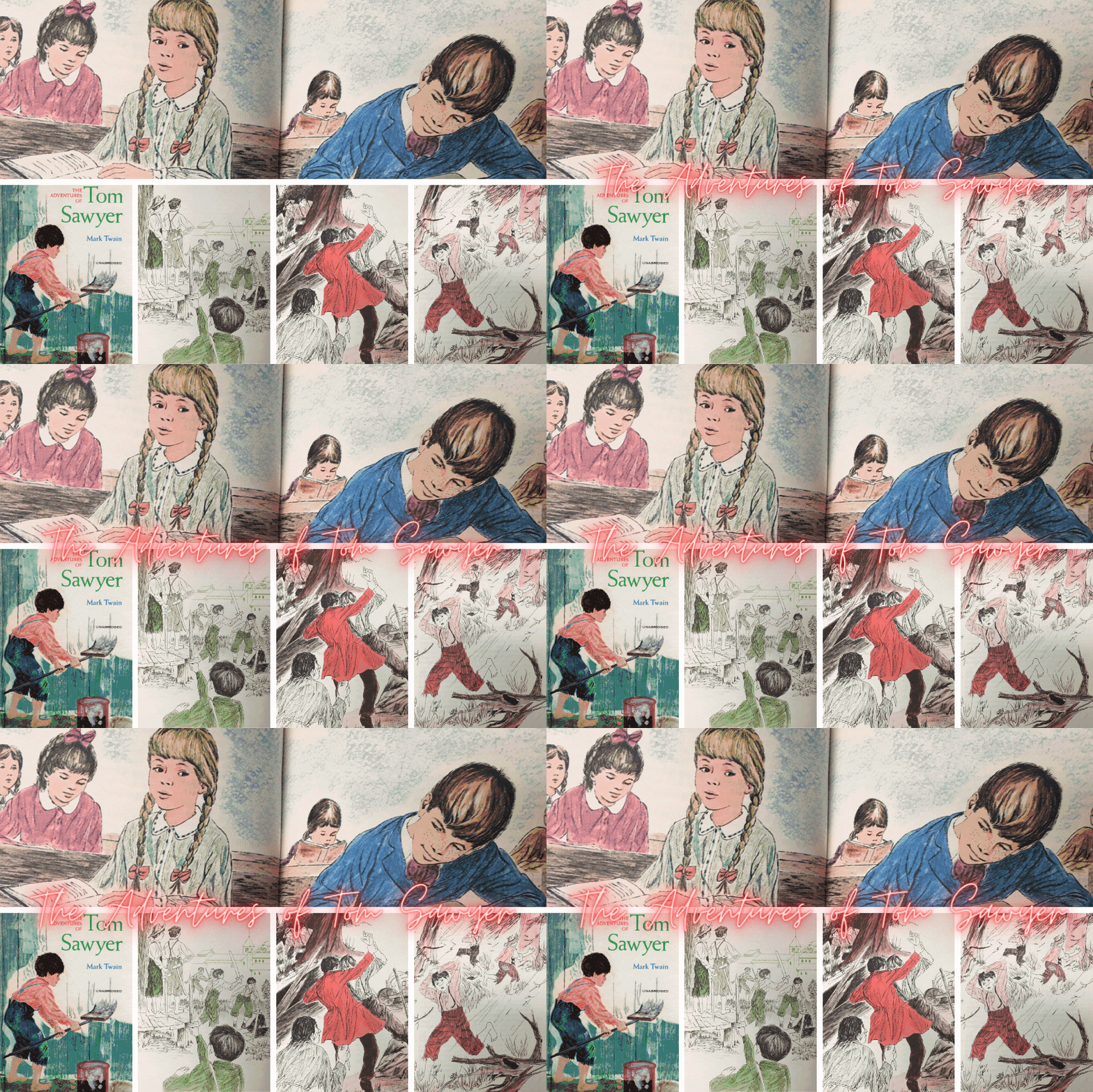
The Adventures of Tom Sawyer by Mark Twain

Golden Press edition

Illustrated by Polly Bolian

I read The Adventures of Tom Sawyer for the Classics Club, and you can find my Classics Club list HERE.

I took a week's vacation with my family at the end of May, right before Memorial Day. We headed into the Colorado Rockies for a camping trip and I intentionally brought The Adventures of Tom Sawyer with me. I read it countless times as a child and a teenager, but it had been many, many years since I'd last picked it up. I still have my original copy, very careworn at this point, and published before adding forewords and afterwords penned by the so-and-sos and whos-who of the literary world became the trend.

It seemed just the ideal reading choice for a stream-side campsite surrounded by woods, and it was indeed so.

Read More

Jane Eyre read-along coming on May 29th!

Tuesday, April 19, 2016


My friend Hamlette at The Edge of the Precipice loves her read-alongs and this one promises to be lots of fun!


Having never read Jane Eyre, I've always been curious how the book is when compared to the film adaptations that I love so much, mainly the Toby Stephens and Timothy Dalton versions. So this will be an enlightening experience, I'm sure.


I may not post my thoughts on the individual chapters here, but will on her blog. And I will definitely post a final review here. I encourage you, if you love Jane Eyre or want to read it for the first time in a group setting, come and join her read-along on this page.


In my mind I just know that I'll be comparing Jane Eyre with my thoughts on Wuthering Heights and The Tenant of Wildfell Hall. The latter I really need to re-read one of these days and actually write a review of it since it's one of my favorite classics of all time!


So come join us!

Read More

On Reading Emily Bronte's Wuthering Heights

Tuesday, April 5, 2016


Wuthering Heights is quite a story. Whereas with Lorna Doone I struggled with every sentence, I hardly want to put Wuthering Heights down, it's so dark and moody and intriguing. I'm about to chapter 11 . . . Heathcliffe has just returned after being absent for 3 years to find Catherine married to Edgar Linton. Her exuberance over Heathcliffe's return has already raised some issues with her husband (can't imagine WHY!)

Having never seen a film version in its entirety other than the 1939 version starring Laurence Olivier and Merle Oberon, I'm sketchy on the details of the ending. The 1939 version skipped a great deal, resulting in a cleaned-up, nicer version of the story and of Heathcliffe. I know it doesn't end well in reality, that's just a given for this story, but it's interesting reading a classic where I'm not 100% sure of the plot twists.

Things that have already jumped out at me are:

1) Catherine is a spoiled brat and I dislike her intensely. There really is nothing nice to say about her AT ALL. She doesn't treat her husband right or her servants or just about anybody, even her father. The only person she ever treated right or appeared to genuinely love was Heathcliffe, but what a love! Passionate and obsessive and quite a bit terrifying.

2) Heathcliffe has no soft edges. There is nothing kindly or redeemable about him, making him very different from Mr. Rochester who, even though I have yet to read Jane Eyre, I've always liked in the film versions.

3) It's fascinating that the story is told from Ellen's perspective as a memory. It makes for a very intriguing narrative and it makes me wonder how truthful of a narrator she is since she isn't inside anyone else's head but her own. She could be an unreliable narrator of Heathcliffe and Catherine so it raises the question of whether they were like my above descriptions of them or if they weren't as bad as she made them out to be. How good was her memory and who kindly was she intending to be in her depiction of them to Mr. Lockwood?

So says Marlon Brando, one of my favorite actors of all time.

Have you read Wuthering Heights? If so, what are your thoughts on it?

I'm enjoying it, if enjoying is the right word, far more than I imagined possible. Not because I like the characters because I really don't, but because the story fascinates me. It torments and grieves the reader in countless ways.

My personal copy has a label on the back that says it is one of the most unforgettable romances of all time. I disagree. That would be like calling Romeo & Juliet a romance instead of a tragedy. Perhaps it could be a romantic tragedy, but for Wuthering Heights, Heathcliffe and Cathy are tearing themselves apart with this obsession that can't be quenched. There is nothing romantic in their inevitable demise, only sorrow. 

Favorite Quotes so Far


Read More

Update on reading Lorna Doone

Monday, November 9, 2015

Wait, what does "Her baint coom, Maister Zider-press" mean?
I think I must have been expecting something other than what it's giving me. For one thing, all of that old English is KILLING ME. Bleh! Okay, yes, I love Shakespeare. But that's mostly because Shakespeare had a lyrical quality to his writing that simply sucks me into the story. Everything makes sense, everything has a purpose and a point to it.

What is the point of John Ridd riding his cousin Tom's horse and nearly getting killed while doing it? I'm afraid that R.D. Blackmore found far too many side plots than he needed and managed to incorporate every single one of them into this story.

Combine that with the extremely old English and I'm floundering a bit.

When John was fishing in the icy stream and found his way into the Doone valley, I was interested. Those scenes had everything to do with the plot and because I already know some of the story from the film version, I was fascinated at how they were similar and how they differed.

Overall, though, this is one looooooooooong book and I would give anything for those characters with the dialogue I can't understand to just go crawl away into some other story!

As an update, I'm about 110 pages into Lorna Doone and I will persevere, but who knows how long it will take me to finish!

Has anyone ever read Lorna Doone before? What was your impression of it? How long did it take you to read it?
Read More

Classics Club Spin Choice!!!

Monday, August 24, 2015


The Classics Club chose #5 for the spin number, and for me that ends up being Lorna Doone!

Now, about this story.

I love the movie version from 2000 with Aiden Gillen and Richard Coyle. It's the epitome of an epic romance for me, beaten maybe only by Ivanhoe. Except that Lorna ends up with the guy she's destined to be with, unlike poor Rebecca and Ivanhoe.

But it is possible, in fact likely, that Blackmore's story is very different from the film I hold so very dear. This is why I'm halfway dreading reading the book because what if it ruins my opinion of the movie? I've had that happen before and really frustrated myself! So let's pray this isn't going to be a repeat of past experiences.

Ooh, and as a means of inspiring myself to read and finish this book, since I didn't own my own copy, I purchased the one to the left. It's from 1889, and yes in not the best condition, but I love vintage books! And it's even illustrated which is always a plus.

Unless we're talking Edgar Allan Poe. Then illustrations are a definite negatory for me. I'd rather read his stories with absolutely no imagery other than what's in my head. My head usually doesn't come up with quite as gruesome of images as the illustrators.

So, there we have it, Lorna Doone is my Classics Club Spin for September and October!
Read More

Classics Club Spin

Sunday, August 23, 2015


This is an event from the Classics Club! I wasn't going to participate and then figured, why not. At least I would have 2 months in which to read whichever book gets chosen from my list and that is quite doable.

The way this works, I list 20 books from my Classics Club reading list of unreads, and tomorrow the Club admins or whoever they are pick a number randomly and I read whatever book correlates to that number. Get it? Got it. Good!

Moving on to the books.
  1. Bunyan, John: The Pilgrim's Progress (1678) 
  2. Trollope, Anthony: Phineas Finn (1869) 
  3. Dumas, Alexandre: The Man in the Iron Mask (1850) 
  4. Fitzgerald, F. Scott: The Love of the Last Tycoon (1941) 
  5. Blackmore, Richard Doddridge: Lorna Doone (1869) 
  6. Salinger, J.D.: The Catcher in the Rye (1951)
  7. Cather, Willa: Death Comes for the Archbishop (1927)
  8. Wells, H. G.:The Time Machine (1895) 
  9. Woolf, Virginia: A Room of One’s Own (1929) 
  10. Dickens, Charles: Little Dorrit (1857)
  11. Burnett, Frances Hodgson: The Making of a Marchioness (1901)
  12. Melville, Herman: Moby Dick (1851)
  13. Fitzgerald, F. Scott: The Beautiful and Damned (1922)
  14. West, Nathanael: Miss Lonelyhearts (1933) 
  15. Stevenson, Robert Louis: The Black Arrow (1888) 
  16. Collins, Wilkie: The Woman in White (1859)
  17. Du Maurier, Daphne: Rebecca (1938) 
  18. Bronte, Charlotte: Jane Eyre (1847)
  19. James, Henry: The Wings of the Dove (1902) 
  20. Conrad, Joseph: Heart of Darkness (1899) 

All right, great spinners, spin on! I am ready for thee!!
Read More

My next Classics Club read shall be . . . The Iliad by Homer

Sunday, July 26, 2015

I've been struggling quite a bit in how to round out my Classics Club reading list because everything appears to be written in the 1800s, probably because I love the British Romantics and the Victorians.

Such an ideal moment.

I'm walking through the Friends of the Library bookstore, just browsing, not really looking for anything specific.

Two small volumes catch my attention.

I whip them off the shelve.

It is Homer's The Iliad and The Odyssey.

Wait, they're not on my classics reading list.

Hmm, maybe they should be.

A 1/2 price sign twinkles at me from the bookstore entrance.

Coins clatter onto the counter and I walk out having paid $1.00 for both books.

Concluding my fun little story, my next Classics Club read is The Iliad, a book I have never read before, but am excited to try. No, it's not written in Greek because, much to your astonishment I'm sure, I don't actually read Greek. The book is translated by one W.H.D. Rouse, and I have no idea whether the translation is decent. My knowledge of The Iliad extends to it being originally written as an epic poem and intended for dramatic recitation and that knowledge goes no further.

So, dear friends, wish me luck!

And if you know of a better translation, please, please let me know!
Read More

Classics Club (Book and Film): Something Wicked This Way Comes by Ray Bradbury (1962)

Sunday, July 19, 2015

Something Wicked This Way Comes
by Ray Bradbury
1962
✯✯✯✯

So I'm finally back on track with my Classics Club reading, although I did considerably shorten the list to only 50 books. Since Ray Bradbury is one of my favorite authors, I figured I might just as well start (or rather re-start the list) with him.

With Bradbury you really never know what you're going to get. His mind worked in weird and wondrous ways that often included lyricism beyond belief and at least one metaphor, simile, or idiom per sentence. This makes his work either difficult to absorb or it absolutely enchants the reader. I'm fortunate in that I fall into the latter category, but I sincerely appreciate and sympathize with the readers that simply cannot get into Bradbury's work.

Something Wicked This Way Comes opens with a lightning rod salesman, heading into Green Town, Illinois to ply his trade. Along the road, he encounters two thirteen-year-old boys, Will Halloway (born a minute before midnight on October 30th) and Jim Nightshade (born a minute after midnight on Halloween). The salesman proclaims that a storm is coming and that one of the boy's homes is in grave danger . . . the home of Jim Nightshade. And instead of charging the boy, as he ordinarily would, the salesman gives away one of his lightning rods. He is a man who runs ahead of the storm and right now, he feels in his bones that a massive one is just around the corner.

Now, these two boys couldn't be more different from one another. Jim Nightshade is a dark-haired rebel who yearns for adventure and loves rule-breaking. He dreams of the day he will be a man in a man's world. But Will Halloway, blonde-haired and content, enjoys life just the way it is. He's the rule follower, the one who would never think of jumping off a cliff until Jim talks him into it. Two such very different thirteen-year-old boys and they are best friends. Which means they were guaranteed to make trouble for one another.

The night that Jim Nightshade reluctantly hangs the lightning rod on his house is October 24th. And it is the same night that a carnival train rolls into the sleepy little town. Will and Jim, neighbors as well as friends, poke their heads out their window and Jim is off like a shot. Throughout the day they've scented the popcorn and cotton candy of a carnival, head the distant sound of a calliope, seen a flyer announcing the arrival of Cooger and Dark's Pandemonium Shadow Show. All before it actually arrives. So now Jim can't be held back and when he hears that train approach, it doesn't matter that it's 3am on October 24th, he tears off into the darkness, Will screaming after him to not go alone. The two boys witness the unveiling of the carnival, in the dark at 3am, and nothing about the carnival looks normal, all dark and cold and terrifying to blot out the stars. How does it appear the following day? As a normal, bedraggled circus on its last legs, except that it leaves a queasy feeling in the pit of Will's stomach and a thrill of excitement down Jim's spine.

Such begins the terrifying little tale that is considered among some of Bradbury's finest work.

As I said earlier, it's impossible to predict what Ray Bradbury is going to give you in one of his novels. But readers do know one thing, that it will be a thrilling, ethereal ride to a world so like our own and yet . . . not. You are transported, perhaps even against your will, by Bradbury's perfectly honed prose to a world beyond imagining.

In the case of Something Wicked This Way Comes, the story works, and works well, at least 80% of the time. Unfortunately, the 20% lag comes at inopportune times where I very nearly yielded to temptation and skipped ahead just to get the plot going again. Anyone who knows Bradbury's style knows that he meanders. Something of a lesser scale George R. R. Martin if aficionados were to be perfectly honest, but at least Bradbury limits the amount of words that he puts on paper and so it is possible to wend your way through one of his books fairly quickly.

Yes, parts of Something Wicked were monotonous. Particularly when the boys are in hiding from Mr. Dark and it takes forever for something to actually happen. But when it does happen, when the plot moves itself along, it's quick as lightning.

While I didn't delve too deeply into the actual plot of this book, mostly for fear of giving away too much because that would be very easy to do, know that the theme is pure genius. What would you do if given the chance to live forever? And not just live forever, but actually choose the age you would appear to everyone else? It sounds like a dream, but as so often happens, when dream becomes reality, there's usually a twist and then it is no longer a dream, but a living nightmare. Such is the case of this story. Promises are made, but certain details left out, and before some of the characters know it, they are far different than they could have imagined.

What I appreciated most in this story was the relationship between Will Halloway and his aged father Charles Halloway who is the janitor for the local library. Charles married late so when Will is 13, his father is well into his mid-fifties. Communication suffers between them due to the age gap, a fact that both Will and Charles regret, and which this story mends. Charles Halloway stops feeling old and Will Halloway stops seeing him as old. The fracture in their relationship is healed.

Then you have Jim Nightshade. Ah, Jim, how to describe you? There isn't anything he won't try. And it irks him that he's still a boy when what he wants most is to be a man. He's predictable in his unpredictability. If there is something dangerous or ill-advised, he'll chase it, like the carnival train and like life itself, wanting something before it's his time to have it.

This book, like nothing else, will give the reader an appreciation for what they have right now, for where they are right now, instead of always looking off to the future and never thinking of the present (to paraphrase Yoda). There are still parts of it I don't understand, like the lady in the ice coffin who was so beautiful and then just disappears and seems to have added nothing to the story except a yearning for some inexplicable something for Charles Halloway. I'm sure Bradbury knew what he meant, but I'm not following his logic in some places, but I learned long ago that it was acceptable and even expected to never understand everything Bradbury wrote. Something Wicked This Way Comes, in spite of it's slow-movements when the reader wants to charge ahead, is brilliant and exciting and I literally never wanted to put it down when I picked it up. It's that good.

Parental Advisory: Violence in a very poetic way with psychological and disturbing images of fear. There are moments when Mr. Dark threatens Jim and Will, and there's another moment where a younger boy is threatened by a much older man (crucial and not as it seems). There's also a witch, supposedly, who's eyelids are sewn shut with black thread, quite scary as imagery goes. What disturbed me most is Jim's addiction to this one house that adults use as a place of debauchery. He climbs a tree and stares in the window at what he calls the stage, and whatever he's seeing isn't good for a boy of only thirteen, or for anyone really. Will saw it once, regrets it, and constantly urges Jim to not go back to that house. In other words, not a book for children, but not a dreadful book either, just psychologically scary, which is what readers should expect from Ray Bradbury.

Then you have the movie, from 1983.

I'm sure the director had good intentions. Bradbury, it appears, even wrote the screenplay, although why he would have is beyond me.

The film is atrocious, an absolute slander against Bradbury's original work that takes everything he did and upends it. Everyone who read the novel understood that the lightning rod salesman wasn't predicting an actual, physical storm. It was always a prediction of the carnival, always. Not the physical storm this film suddenly placed front and center. The lightning rod salesman's end isn't the same, neither is the school teacher's end, or even the end of Mr. Dark. I understand his end in the book was probably very disturbing, but his end in the film was even more grotesque.

I reached the point of fast-forwarding through bits that were absolute rubbish, which was most of it. There are moments when Bradbury's prose is used, but not nearly enough of them. Overall, it is an abomination of the original story and I'm ashamed it was ever made and that I ever deigned to watch it. Rumor has it that Disney is remaking the film, but they didn't do such a good job the first time around so I'm not holding out much hope for a successful remake.

It's a shame that back when Bradbury first came up with the notion that Gene Kelly wasn't able to sell it as a screenplay and do it himself. Gene was a huge supporter of the premise (it was simply a screenplay idea at this point, not a novel), and the two were such good friends, that it would have been a rousing success. Sadly, he couldn't find the funding. No one was daring enough to give it a go in the 1950s, so now readers have an incredible book and an absolute stinker of a film.

Ah well, books are longer lasting anyway and I anticipate that people will still be reading Something Wicked This Way Comes when the film has long since faded into anonymity. One can only hope.
Read More

Classics Club Spin Read: I Capture the Castle by Dodie Smith (1948)

Sunday, August 31, 2014

This is actually the very first book I read for my Classics Club challenge. It's delightful to feel that I've gotten started on this project, finally, after 8 months of having no interest in beginning. So it was probably providential that I began with a book I had never read and really had no knowledge about. I not only read the book, but also went out of my way to watch the film adaptation for I Capture the Castle from 2003, so I will also include a write-up about the movie at the end of this post.

For the uninformed, this story is essentially the journal of a young 17-year-old girl named Cassandra Mortmain and takes place sometime in the 1930s. Cassandra has inherited her father's gift for prose, but unlike him, she does not suffer from writer's block. Her family lives in a castle but are actually the poorest of the families in the area, to say nothing of being a bit odd. Her father, a man who goes by his surname, wrote exactly one book in his life, Jacob Wrestling, and it was a monumental success. But after a bout of lost patience with his first wife, and being thrown into prison for 4 months for violent tendencies, he was never able to write again. At the castle, he lives in the gatehouse and reads detective stories, putting forth not a single effort to write.

Cassandra's older sister, Rose, can hardly stand being so poor, so poor that they are fortunate to have enough food on the table, especially when the royalty checks from Mortmain's only novel dry up. Stepmother, Topaz, does the best she can with what she has, but that isn't much considering Mortmain refuses to speak with her on any personal level, and she, as an artist herself and one-time model, stagnates with no one to encourage and no society to attend. Thomas, the youngest child, engrosses himself in his books, and Stephen, their "hired" hand who hasn't been paid in months, loyally does what he can to put food on the table, far more than Mortmain ever does. Stephen even takes his earnings from a second job to assist the Mortmain family, partially out of devotion to the family itself and partially out of his unrequited love for Cassandra.

All of this Cassandra jots down in her journal, her effort to capture the castle and the people living in it. And her journal might have been quite dull had not Neil and Simon Cotton put in an appearance. They have inherited the estate on which the Mortmain's castle resides, Simon being the heir to a vast fortune, and his brother Neil along for the ride from America. Rose, so desperate to escape poverty, is determined to marry Simon, whether she loves him or not, and quite rapidly games of love ensue that have all the characters scrambling, including Cassandra herself who wishes so desperately that she could love Stephen, but simply cannot.

Yes, this is a depressing book. Not all the time, and not for the first half, but it rapidly swivels in that direction once Rose and Simon are engaged. I wish I could have liked it better than I did. It's not that the characters weren't likeable because most of them were, even Topaz with her odd fondness for walking the exterior of the castle nude in the middle of the night. The characters are all unique, with varying personalities, and I am extremely fond of Cassandra herself, even though she wavers between being forthright and romantic. Poor Rose, so desperate for escape, and poor Stephen, whose every compassionate and caring gesture was meant to garner Cassandra's love somehow.

I think part of my befuddlement is that I have no familiarity with romantic love. I see it in movies and read about it in books and hear it in songs, but I have never once been in love myself. So I quirk my head at Rose's insistence that she cannot love Simon and at Cassandra's reticence to return the romantic feelings of her faithful (most of the time) Stephen. Many romantics believe that love is solely a feeling of excitement in the heart alone. I don't believe that. There have been two times in my life where I could have fallen in love, but I shut down the emotion because it was the wrong man. It would have been one of the worst choices of my life to have romantically loved either of these men, and so I walked away emotionally and here I am, completely whole and without having sacrificed by values for something called "romantic" love. I prefer to think of love as being a head/heart decision. The heart cannot simply run away from the head like it does, like most of us simply allow it to do. I think that's one reason why I like the movie The Painted Veil with Edward Norton. The heroine does not love her husband, at all, at the start of the story. She marries him for security, but no romantic attachment. By the end of the story she is deeply in love with him on levels that go beyond mere physical desire. That is true love and that is what I Capture the Castle lacks.

Then there is Mortmain. It is difficult to read the story of a man who refuses to support his family. He is an artist, a writer, and he refuses to be anything else, even to put food on the table. Instead his duties fall on the shoulders of Stephen, a young man not even of his own flesh and blood. It was painful to read, albeit less painful to watch in the movie since they softened him somewhat. Where Mortmain is concerned, I would say Dodie Smith did a fine job of portraying the starving artist. The thing I hated about him is that he forced his family to starve right along with him.

So, while it was very well written, Dodie Smith failed to capture more than the barest hint of love, choosing instead to play with fluffy feelings that are based solely in the heart and not at all in the head. As Tintin would say, "I'm a realist" and so this story with all its ups and downs and misinterpretations of love and no one really having a happily ever after wearied me beyond measure. As if somehow happiness is only brought about by our feelings.


Now that you know my opinions of the book, let me say that the film version of I Capture the Castle was fairly accurate. It was done in 2003 and starred Romola Garai (Cassandra) and Bill Nighy (Mortmain) as well as a very young Henry Cavill as Stephen. They tried to stick as close to the original story as possible, which was both good and bad since I had my own issues with the original. I will say that the moments I had wanted the movie to expound on from the book were either too short or skipped entirely. Also, I was never entirely sold on Romola's performance as Cassandra, which is probably not her fault just a fault in the casting. Rose Byrne was exquisite as Rose, and Tara Fitzgerald fit my imaginings of Topaz perfectly.

Yes, the film is R rated for topless female nudity. Remember, Topaz is a nudist sometimes, and we do see Cassandra sunbathing alone on I'm assuming one of the castle ramparts or parapets or whatever you would call them. Mortmain is more relatable to me in the film, probably because he is Bill Nighy and I happen to love him. He's suffering from guilt and shame and the loss of his first wife and had nowhere to put those emotions for so long. By the end of the story he's a much improved man. But my personal favorite was Marc Blucas as Neil Cotton. Don't ask me why I like him, but I always have, even during his season on Buffy: The Vampire Slayer.

So, if you want a movie like the book, than this film does a pretty stellar job. It has all the same romantic flaws as the book, and I wanted to smack several people upside the head numerous times, not the least of which being Cassandra herself. It was pretty, and adequately cast, but not one I would watch again, or even a book that I would probably ever read again.

There you have it. I finished my first read for the Classics Club Spin. Yeah for me!
Read More

The Classics Club Spin

Monday, August 11, 2014

So, I joined The Classics Club several months ago and have yet to read a single classic. This might be as good a time as any to start. The spin works with me choosing 20 books from My List and labeling them as 1 to 20. I will do as the challenge suggests and pick 5 that I'm reticent to read, 5 that I'm dying to read, 5 that I'm neutral about, and 5 that will be re-reads for me. It seems that the challenge is sort of a 3 week per book reading schedule, which shouldn't be too hard to stick to.

The first spin is #17, which I looked up only after I created this list. I'm quite neutral about I Capture the Castle so we'll see how I like it. I have no opinion whatsoever going in!

  1. Bunyan, John: The Pilgrim's Progress (1678) 
  2. Dumas, Alexandre: The Man in the Iron Mask (1850) 
  3. Hawthorne, Nathaniel: The Scarlet Letter (1850)*
  4. Dickens, Charles: Little Dorrit (1857)
  5. James, Henry: The Portrait of a Lady (1881)
  6. Pyle, Howard: The Merry Adventures of Robin Hood (1883)*  
  7. Wilde, Oscar: The Picture of Dorian Gray (1890)* 
  8. Stoker, Bram: Dracula (1897)
  9. Conrad, Joseph: Heart of Darkness (1899)
  10. Wharton, Edith: The House of Mirth (1905)
  11. Leroux, Gaston: The Phantom of the Opera (1909) 
  12. Fitzgerald, F. Scott: This Side of Paradise (1920)
  13. Cather, Willa: Death Comes for the Archbishop (1927) 
  14. Woolf, Virginia: A Room of One’s Own (1929)
  15. West, Nathanael: Miss Lonelyhearts (1933) 
  16. Du Maurier, Daphne: Rebecca (1938) 
  17. Smith, Dodie: I Capture the Castle (1940) 
  18. Salinger, J.D.: The Catcher in the Rye (1951)
  19. Lewis: C. S.: Till We have Faces (1956)*
  20. Lee, Harper: To Kill a Mockingbird (1960)*

* Indicates a re-read.
Read More