Showing posts with label radio theater. Show all posts

Radio Theater: Orson Welles in Dracula (7/11/1938)

Tuesday, October 19, 2021


Dracula 

Starring: Orson Welles, Elizabeth Fuller, George Colouris, Agnes Moorehead, Martin Gabel, Ray Collins, Karl Swenson 

Studio: Mercury Theatre on the Air 

Year: July 11, 1938 

My Rating: ★★★★★ 

Available free from The Mercury Theatre on the Air (if you have trouble listening or downloading, you can also listen to it here on YouTube) 

The Mercury Theatre on the Air started its short but illustrious life with Dracula by Bram Stoker in July of 1938. Orson Welles could not have chosen a better story to launch this radio theatre to stardom although it would inevitably be War of the Worlds that would keep it famous.

Go to my Classic Hollywood page to find all my Classic Hollywood reviews!

While I have never actually read Dracula all the way through because it is epistolary, I do know enough about the story to know that, while seriously abridged, this radio version of Dracula is outstanding, to say nothing of spine-chilling. All of the main characters are who they should be, meaning that Lucy and Mina aren't related or even friends, Dr. Seward is not a bumbling old man running a sanitorium, and Jonathan Harker is a poor, traumatized young man who barely escapes Transylvania with his life. Barely. The program even includes the carnage of the ship Demeter, an important element also referenced in the 1979 film version of Dracula starring Frank Langella. 

As you're already all well aware, I love Orson Welles' radio plays. Absolutely and with abandon. If I could live in his radio plays, I would, and while Dracula is a haunting story, it is beautifully rendered in this production. The sound effects, the musical score, the performances, everything flawlessly aligns. I cannot praise it enough. I find myself sinking deeper and deeper into the story as it continues, and while there are characters and storylines omitted for the sake of time, it is still exquisite. 

Life is made better by Orson Welles and his radio career, and Dracula proves that point.

Read More

Radio Theater: Lionel Barrymore and Orson Welles in A Christmas Carol (12/24/1939)

Tuesday, November 17, 2020

I wrote this blog post to participate in The Sixth Annual Barrymore Trilogy Blogathon hosted by In the Good Old Days of Classic Hollywood. 

A Christmas Carol

Starring: Lionel Barrymore, Orson Welles, Everett Sloane, Frank Readick, Erskine Sanford, George Coulouris, Ray Collins, Georgia Backus, Bea Benaderet, and Edgar Barrier

Aired: December 24, 1939

My Rating: ★★★★★

In all the world, there is no story I love better than A Christmas Carol by Charles Dickens. I collect different and unique print copies of the book, have watched countless versions so long as they preserve the spiritual and social message of Dickens, and have tracked down many different radio dramas and narrations performed throughout the years.

But my favorite radio version, by far, aired on December 24th, 1939, and stars the superlative Lionel Barrymore in the role of Scrooge, with Orson Welles as the narrator.

Go to my Classic Hollywood page to find all my Classic Hollywood reviews!

There is a radiant nostalgia in this particular performance. Orson Welles has always been and will always be my favorite radio theater performer, and so I know I have a lot to thank him for in regards to this version. But there is nothing like Lionel Barrymore's performance. Orson actually played Scrooge in the 1938 production of A Christmas Carol, and I like that version as well, but just as I feel that Sir John Gielgud and Sir Ralph Richardson were meant to perform as Holmes and Watson in their radio series, so too was Lionel Barrymore born to play Scrooge.

Lionel's performance helps the listener see the events as they happen. He sells the idea of ghostly apparitions and heartfelt grief over memories and choices made in the past, and his fear of the future. Two years ago, my father and I sat in front of the fireplace in the living room and just listened to this play, completely ensconced in the world of Charles Dickens. That takes not only a magnificent author like Charles Dickens, and a magnificent narrator like Orson Welles, but a superior performer like Lionel Barrymore for Scrooge.

The briefest segment is with the Ghost of Christmas Yet to Come, chopping out the scenes with Scrooge's business partners and the characters who stole from "Scrooge's" corpse. It's an unfortunate omission, but they couldn't fit everything into the production and squeeze it into an hour. Overall, the story itself preserves all of the spiritual and supernatural elements that make up A Christmas Carol. It's a stunning representation of redemption and proof that a person can change and be someone else, a fact I have always and will always believe, but is important to be reminded of sometimes in literature.

A Christmas Carol aired over the American airwaves as a Christmas gift from the Campbell Soup Company to their buyers and listeners eighty-one years ago. And we have the blessed opportunity to listen to it today. What a miraculous job of preservation, and I extend a heartfelt thanks to Campbell Soup for this beautiful production of A Christmas Carol.


I wrote this blog post to participate in The Sixth Annual Barrymore Trilogy Blogathon hosted by In the Good Old Days of Classic Hollywood. Please click the link or the photo below to read the posts by the other participants.


Read More

Radio Theater: Orson Welles in Around the World in Eighty Days (10/23/1938)

Wednesday, September 23, 2020

Around the World in Eighty Days

Starring: Orson Welles, Ray Collins, Edgar Barrier, Eustace Wyatt, Frank Readick, Arlene Francis, Stefan Schnabel, Al Swenson, William Alland, Howard Hughes

Year: October 23, 1938

My Rating: ★★★★

Available free from Indiana University Bloomington

I've never read this particular novel either, although it is on my list. However, I did watch the 1989 miniseries starring Pierce Brosnan as Phineas Fogg so I'm quite familiar with the story. 

Go to my Classic Hollywood page to find all my Classic Hollywood reviews!

Phineas Fogg is a wealthy Victorian gentleman who runs on time. Every moment of his life, down to the last second, is accounted for. So when members of his club place a wager with him that he cannot make it around the world in 80 days when he positively claims he can, well, the race is on. Phineas' journey involves steam trains, ships, boats, elephants, and more, all accompanied by his new French manservant Passepartout, a loyal man who likes his new master but also thinks he's CRAZY, and he wouldn't be far wrong. But the greatest question is, can Phineas actually deliver on his promise to make the trek in 80 days, or will his faith in Father Time ultimately fail him in the end?

This play is very nearly brilliant. Orson approaches the role of Phineas Fogg with a delightful bit of snobbery in his voice, making the character very memorable. I've heard Edgar Barrier before, playing the voice of the hotel manager in Private Lives, so it was fun to have him play Passepartout as well. He uses such an eccentric and hyper French accent that just works for the role.

The script is good, very, very good, but, due to the shortness of time, there are days and weeks that are simply mentioned in narration as having happened, Phineas hopping from train to boat, etc., without actually seeing these scenes. It's a shame, but also understandable that the audience is unable to experience everything. Unfortunately, this also means that the listeners don't have time to really engage with the love story so that bit feels a little, shall we say, sudden? Considering the lack of time, however, this play is concise, clear, and easy to follow, even for those with no familiarity with the story.

Around the World in Eighty Days is, quite simply, a fun romp around the world with Orson Welles. It's entertaining and quirky and one of my favorites of Orson's radio productions.

Read More

Radio Theater: Orson Welles in A Tale of Two Cities (7/25/1938)

Monday, September 14, 2020

A Tale of Two Cities

Starring: Orson Welles, Mary Taylor, Edgar Barrier, Martin Gabel, Frank Readick, Betty Garde, Erskine Sanford, Ray Collins, Kenneth Delmar

Year: July 25, 1938

My Rating: ★★★

Available free from Indiana University Bloomington

This review will be quite brief.

I have listened to this radio play at least a half a dozen times, but it still confuses me. I partially blame my confusion on Mr. Welles' adaptation that feels a bit jumpy, but also on my having never read A Tale of Two Cities by Charles Dickens. My unfamiliarity with the story makes it hard for me to focus and if I have just a few minutes where my mind wanders, which always seems to happen, well, that's the end. And I spend the rest of the play struggling to keep up.

All I do know is that it is a very condensed version of Dickens' novel. It has to be or they could never fit the story into an hour. 

Go to my Classic Hollywood page to find all my Classic Hollywood reviews!

Orson Welles gives a stellar performance as both Dr. Alexandre Manette and Sydney Carton, two men who are alike in appearance and voice but in no other way. My brain disengages about 10 minutes in and re-engages about 15 minutes from the end when I realize that Dr. Manette is about to be executed during the French Revolution and Sydney Carton, a man who has never done anything for anyone, decides to take his place. The final several minutes are very moving and fit well into my expectations of Orson Welles' emoting abilities.

The only reason I've listened to this radio play so many times is because it is the first play in my complete Audible collection of Orson Welles' plays. I forget that every single time and am simply too lazy to skip ahead. I must keep hoping that the story will someday click in my brain. Alas, it hasn't happened quite yet.

However, if you are familiar with Dickens' A Tale of Two Cities, then I have no doubt you will enjoy the radio play.
Read More

Lucy on the Radio: Dinner at Eight (Campbell Playhouse, 1940)

Thursday, August 6, 2020

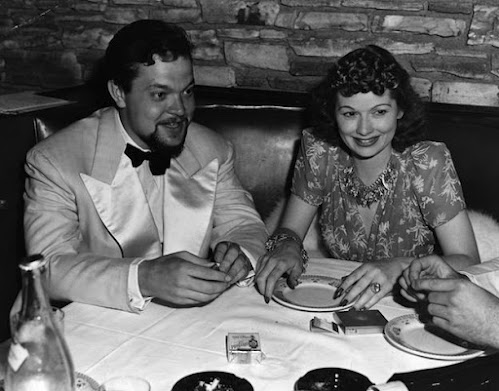
Lucille Ball and Orson Welles in 1940


a blog post written for my We Love Lucy Blogathon


Edna Ferber's theatrical play, Dinner at Eight, was adapted for radio by the Campbell Playhouse in 1940. One of Orson Welles' productions, Dinner at Eight guest-starred Lucille Ball in the role of his wife, a character much like her role in Fancy Pants with Bob Hope, slightly uncouth and uncultured.

A farcical look at upper-class arrogance and oneupmanship, Dinner at Eight never actually shows the dinner, but all of the events leading up to the meal, including the hostess' difficulty in obtaining the correct number of people from the correct social class. She's forced to invite a couple from Texas, played by Orson and Lucy, who are potentially her least favorite people in the entire world due to their coarse manners and habits.

Go to my Classic Hollywood page to find all my Classic Hollywood reviews!

I'm a bit of a radio buff and a huge Orson Welles radio fan, so it only made sense that I would eventually stumble across this play, but what I wasn't expecting was Lucy. In fact, I hadn't even paid much attention to the credits at the beginning as I was listening, and then Lucy's voice woke me right out of my reverie. 

Read More

Radio Theater: Sir John Gielgud and Sir Ralph Richardson as Holmes and Watson (1955)

Saturday, August 10, 2019

The Adventures of Sherlock Holmes radio series starring John Gielgud and Ralph Richardson


I'm on the eternal hunt for the ideal Holmes and Watson pairing.

Oh, of course, many come close, like Jeremy Brett and David Burke in the celebrated BBC television series from the 1980s, or even Ian Richardson as Holmes, but alas, I can't recall his Watson, which is never a good sign.

Photo of Sir John Gielgud
Sir John Gielgud
But I believe I may have finally found the ideal paring in Gielgud and Richardson, both esteemed stage actors in their own right with all of the professional training needed to make radio theater a success.

In a word, they're marvelous.

I mentioned Ian Richardson a moment ago, and I actually hold him up as the ideal Holmes. They only thing he didn't have was Holmes' height, but everything else was absolutely 100% spot on, from his mannerisms to his appearance.

John Gielgud is the same, only on the radio.

One doesn't need much imagination to conjure an image of Sherlock Holmes while listening to Gielgud's radio theater performance. He has just the right touch of arrogance and humility in his performance, the proper notes of conviviality paired with the behavior of a social recluse. That mixture is what makes Arthur Conan Doyle such a delight to read. It's not everyday that a lead character can be offensive and still likeable.

Gielgud plays Holmes with a genuine fondness for Watson, a nice change from some of the more unpleasant incarnations of the man, and he absolutely sells that the story is happening in real time, at this very moment. No small feat.

Photo of Sir Ralph Richardson
Sir Ralph Richardson
Then there is Ralph Richardson, not to be confused with Ian Richardson. RR is a marvel. I've not encountered him very often in my movie watching ventures. He just sort of slipped on by me, as it were, although he does play Lord Mere in The Divorce of Lady X with Laurence Olivier and Merle Obern, one of my favorite romcoms from the 1930s.

I guess the real question is who do you see when you think of Dr. John Watson? I don't see an idle, fat man with absolutely no brains at all. I'll be forever troubled that Watson is often cast as such when there is no evidence at all in the canon that he was overweight and stupid. Opposite Holmes, almost anybody would seem stupid.

RR's Watson is delightfully amiable, awash with a warmth and enthusiasm for life that just makes the listener smile. He can and does keep up with Holmes on their ventures. His radio theater performance in The Dying Detective, the hurt and dismay he feels in thinking Holmes doesn't trust his expertise as a doctor, is perfection itself. Those authentic emotions are like nothing you have ever heard.

As if it were possible to improve on perfection, somehow this radio theater series managed it in the simple act of casting Orson Welles as Professor Moriarty in The Final Problem. Welles delivers an understated, calm performance as the devious Moriarty, a refreshing change to the Moriarty performances which hint at just a bit of crazy.

Sir John Gielgud, Sir Ralph Richardson, and Orson Welles performing the radio play Sherlock Holmes: The Final Problem
Sir John Gielgud, Sir Ralph Richardson, and Orson Welles

Paired together, Sir John Gielgud and Sir Ralph Richardson elevate the Holmes canon with their performance.


They show how the stories can and should be performed. I would give almost anything for a new television rendering of the stories if I trusted the BBC to get it right. But I don't trust them to not stay true to Doyle's original stories, so there's no point in my even going on about it, alas.

On a complete side note, my one annoyance with the series is the narrator's continued ignorance. He insists on calling Watson, Dr. James Watson! I mean, really!?

The radio series has 16 episodes (how I wish it were longer!)

Dr Watson Meets Sherlock Holmes
A Scandal in Bohemia
The Red-Headed League
The Six Napoleons
The Blue Carbuncle (an absolute gem)
The Speckled Band (shivers galore)
The Disappearance of Silver Blaze
The Golden Pince-Nez
A Case of Identity
The Final Problem (an absolute must)
The Empty House (again, an absolute must)
The Second Stain
The Bruce-Partington Plans
The Dying Detective (my personal favorite)
The Norwood Builder
The Solitary Cyclist (another favorite)

You can find them all HERE for free streaming, which I think is a lovely service.

If you do get a chance to listen, what is your favorite of the stories? What do you think of the performances? And, most especially, which of the Holmes stories do you wish they had performed!
Read More

Radio Theater: Orson Welles in Noël Coward's Private Lives (4/21/1939)

Friday, August 2, 2019

Orson Welles preparing for a radio play


I honestly don't know how I lived before finding Orson's radio theater performances! I mean, seriously!

Private Lives is a crazy combination of hilarity and tragedy that appeals to my macabre sense of humor. Orson Welles plays Elyot and actress Gertrude Lawrence plays his ex-wife Amanda (Gertrude actually played opposite Noël in 1930 in this play on the stage!). Each of these individuals has remarried and each of them is on their honeymoon, I would say the wedding night, actually. And of course, each couple stays in the same hotel!

And of course, they have suites right next to each other!

Elyot and Amanda see each other, turn white as a sheet (assumedly, since it is radio), and immediately beg their new spouses to agree to move to a different hotel. Which is hilarious because each of them wanted to go to Paris so they would have run into each other there too. Apparently, Amanda and Elyot both love the same hotels/resorts. Can't imagine how that happened.

Anyway, the new spouses are frustrated at this new itchy, irritating side to Elyot and Amanda and dig in their heels, refusing to change hotels. Each of the new spouses storms off to have dinner alone in the resort, leaving, CUE DRAMATIC MUSIC, Elyot and Amanda alone!

The divorced couple gets to talking, realizes how very much they still desperately love each other despite the smackdown drag-out fights they indulged in when they were married. Yah, that sounds healthy. After indulging in a bit of desperate guilt, the two set up a phrase, or in this case, a name, Solomon Isaacs, that each of them has the right to say to call a cease-fire for several minutes should an argument break out. Then they run away together, off to Amanda's apartment in Paris.

Whoo boy.

Yes, Private Lives is hilarious.

But my heart also breaks for the other spouses. These poor people, Sibyl and Victor, had nothing whatsoever to do with any of this insanity. The only thing they did wrong was fall in love with fickle people who can't live with each other and can't live without each other either. It's not a comforting thought to realize that the only way your husband/wife would be faithful is if they never saw their ex-spouse in the flesh. Yipes!

Down to the nitty-gritty of the radio theater performance.

Orson uses a delightful hoity-toity British accent as if he were a second son of a lord or duke. It's a lovely accent, made even more so by the absurd lines in the play that he gets to perform. Gertrude must have been a hoot on the stage because I absolutely adore her in the radio play! She has this charming selfishness to her voice that suits the character perfectly. And together, you buy that Elyot and Amanda are still in love. They just sell it, even though they each had their own microphone they were performing from, you can picture them in each other's arms, both arguing and kissing at the same time. It's insane to be able to capture that type of authenticity on the radio!

The secondary casting for Sibyl and Victor was excellent as well. Sibyl (Naomi Campbell) is this sweet little voice that you empathize with because she's right when she says that it's all so squalid. And Victor (Robert Speaight), well, he's a bit of a dullard, sort of white bread with mayonnaise, which is fine, but Amanda should have known better than to marry him. She would have been bored within a week.

And then there's the manager of the hotel. Oh my gosh, I LOVE him and I have no idea who played him. He's this officious little Frenchman who's an impartial observer to the insanity of Amanda and Elyot reconnecting. He's, in effect, the chorus or the narrator, and is positively brilliant.

Private Lives is in my top 5 favorites of Orson's radio theater productions. It's a perfect representation of the 1930s lackadaisical attitude towards marriage and I just can't help loving it.

Laurence Olivier and his first wife, Jill Esmond
Laurence Oliver and Jill Esmond
On a completely unimportant side note, Laurence Olivier performed as Victor in the stage play with Noël and Gertrude in 1930 and even married Jill Esmond, the girl who played Sibyl. This, of course, was before the Vivien Leigh debacle. As the narrator of the radio play would say, "These people are crazy!"

Read More

Radio Theater: Orson Welles as the Count of Monte Cristo (10/1/1939)

Thursday, July 25, 2019


No, you're not looking at a bizarre facsimile of Leonardo Dicaprio. Although I do find it strange that in their youth and based solely on appearance, Orson and Leo could have been brothers.

Ladies and gentlemen, this is Orson Welles.

Most people probably know him for Citizen Kane and The Third Man, the latter of which his role lasts no more than 20 minutes and the former being a film I've not yet watched.

Instead, Orson Welles is my radio theater champion.

If you know of Orson but don't ever recall him playing the Count of Monte Cristo, you would be right, in a sense. He never performed as Edmond Dantes on the screen, but instead lit up the airwaves in a vastly abridged yet brilliant hour long radio play of The Count of Monte Cristo.

Performed October 1, 1939, Orson had yet to advance to the silver screen. He wouldn't move from New York to Los Angeles until November of 1939 when he began his work on what is, arguably, his most famous role in Citizen Kane. 

Instead, he's still in New York, performing every week for radio audiences.

There's nothing quite like the radio of the early Hollywood years. These performers were artists, really. Regardless of your opinion of Orson Welles as a person, no one can deny his epic, masterful voice. 

And he puts all of his skills to work in the role of Edmond Dantes.

I have never read the book. I admit it. I've seen the Jim Caviezel film and been struck by its morbid tragedy, but the book has always seemed daunting somehow. To have Orson Welles pare it down into an hour long performance staggers the imagination.

The story begins as a young and foolish Edmond Dantes trusts the wrong people in his life, young men he thought were his friends. Orson would have been 24 when he played Dantes, a little older than the youthful character, but if there's one thing Orson had, it was mastery of his voice,. He plays young Dantes as an eager to please, hopeful youth who simply wants to marry his sweetheart and live his life.

Of course, the next phase is the betrayal of Edmond by his so-called friends. It is suspected that he is a supporter of Bonaparte and he spends the next 20+ years imprisoned in the Château d'If, a prison island off southeastern France.  There's nothing more haunting than hearing a young man who has done absolutely nothing wrong, scream that he is innocent as the guards lock him away to be forgotten in solitary confinement.

After 6 years of utter silence, Dantes spends the next 6 months attempting to starve himself to death. At least, until a prisoner known as the Mad Priest, digs his tunnel into Dante's cell. The two spend the next 14 years in each other's company, saving Dantes from the sin of suicide.

When the Mad Priest dies of illness and supposed old age, Dantes switches himself with the body and when tossed over the side of the Château d'If, cuts himself free of the shroud and swims off to collect the treasure of Monte Cristo that the Mad Priest had essentially bequeathed to his young friend.

I'm prone to loving Orson when he plays supremely young characters. He imbues a certain whimsy into his lines that is just extremely attractive and charming. But there is nothing more terrifying than Orson as a vengeful Edmond Dantes, recently escaped from 20 years in a French prison.

You would almost think that the time spent in the Château d'If might have tamed the character. But not the way Orson plays him. Instead, Dantes is masterful, a man in his late 30s, performing a convincing masquerade as the wealthy Count of Monte Cristo.

Revenge, of course, is enacted.

I suspect that the last half of the play might be the most condensed since we never know what happens to the villains who betrayed Dantes all those years ago. There's an intense, snarling confrontation when Dantes casts off his mask as the Count of Monte Cristo. But there is nothing after this point, which is probably good because I think one of the men commits suicide, another gets captured by bandits (maybe?), and the third goes insane. At least according to Wikipedia.

I do know that H. H. Holmes (the infamous devil of the White City), read The Count of Monte Cristo during his time in prison, but unlike Dantes, Holmes was GUILTY!

Ahem.

Orson's ability to move from youthful, wistful Edmond Dantes to the avenging devil Dantes is remarkable.

Think of it.

This is radio.

You don't have facial expressions or sweeping gestures to help you. The audience can't see them. All you have is your voice. And that has to be perfect, every time, if radio theater was your career.

If you get a chance, Audible has a 60 hour collection of Orson Welles' radio plays. I've listened to most of them half a dozen times now, and not all of them are classics, but contemporary plays, well, what would have been contemporary during the 1930s. But each of them gives a much more complete view of Orson Welles as a performing artist. Yes, he was excellent on the silver screen. So much so that I wish he'd gone to Hollywood sooner and acted during the 1930s. But if he'd done that, we wouldn't have his radio plays, and that is a sacrifice I'm thankful he didn't have to make.

More reviews of his radio plays to come.
Read More