Showing posts with label frank langella. Show all posts

Rewatching Mel Brooks' The Twelve Chairs in 2022

Monday, April 18, 2022


I rewatch Mel Brooks' The Twelve Chairs (1970) every year. I suspect it's one of Brooks' lesser known comedies, but it's the only one of his films that I religiously watch because it has the least amount of crude content. Go figure!

The setting is 1927 Russia, a decade after the revolution. It's a satirical look at Russia, featuring three lead male characters whose ultimate goal is tied to greed.

Brooks, Moody, and Langella in The Twelve Chairs (1970)

Ippolit Vorobyaninov (Ron Moody) is the main "protagonist." He is a member of the deposed Russian aristocracy, a man born into great wealth, a man awash with pride and arrogance in his youth now brought low after his family's wealth was taken from them. His greed is found in the little things. When his mother-in-law is on her deathbed, his first thought is, "that poor woman, that poor woman," followed by "who is going to take care of me?" Empathy coupled with selfishness.

Langella in The Twelve Chairs (1970)

Ostep Bender (Frank Langella) is the second "protagonist." He is a communist, but first and foremost, he is about himself. His own security, his own safety, his own wellbeing, is his first and only priority. He has been taking care of himself all his life, and so there is nothing he will not stoop to so that he can continue to live. When his and Vorobyaninov's roads cross on a hunt for a dining room suite that inside one chair hides a fortune in jewels, it is the joining together of two equally selfish men.

Deluise and Langella in The Twelve Chairs (1970)

Father Fyodor (Dom Deluise) is the "antagonist" if you could call Ostep and Vorobyaninov protagonists. He takes Vorobyaninov's mother-in-law's final confession, learns about the jewels hidden in that dining room suite, and starts out on his own journey to find those chairs. His hunger for wealth is greater than his holy calling and he casts aside his faith.

Enjoy this fun scene from the film, one of my favorites because it showcases Dom Deluise's brilliant comedic talent!

I make them sound nasty because they really are. These are not likable men. They're laugh-so-hard-until-you-cry hilarious, but they're not nice. And you don't want to be them! These 3 lead characters will do ANYTHING to get this wealth. For Vorobyaninov, it's because he wants to be rich AGAIN. For Ostep, it's because he's never been wealthy, and the temptation of possibly having ENOUGH is overwhelming. And for Fyodor, he's done playing the holy game, and wants an OUT. Selfish motives, one and all, and it can be funny to watch selfish people chase a pipe dream.

Langella and Moody in The Twelve Chairs (1970)

It can also be scary.

Because we're seeing this happen right now, with Russia shamelessly chasing something they used to own, but is no longer theirs. They're doing the same old thing. Does it mean I think all Russians are like the men in The Twelve Chairs? No, of course not, but it is ironic that a Russian satirical story published in 1928 that features greedy men chasing vain ambition should still be so relevant in 2022, almost 100 years later. Maybe some things don't change.

The Twelve Chairs is hilarious. It's got so many belly-laughs in it. Even my sister loves it now, which she didn't when I wrote my Frank Langella and Mel Brooks Unite in The Twelve Chairs (1970) post back in 2016. But it was hard to rewatch it this year, in this moment, at this time. Because the concept is funny when it's a satirical comedy of selfish men, but it's not so funny when the man is someone with what feels like infinite power and what he's chasing isn't jewels hidden in an old chair, but an entire sovereign nation.

Brooks and Langella in The Twelve Chairs (1970)

Kudos to Mel Brooks, that marvelous man of Jewish Polish and Ukrainian heritage who created this movie. He also has a bit part to play as Vorobyaninov's old servant, Tikon, a hilarious role for a hilarious man.

Watch The Twelve Chairs. It's pretty clean with just a smidgeon of vulgarity. Now is the time. 

Note: I didn't make the GIFS, some kind person on Tumblr did.

Slava Ukraini

Read More

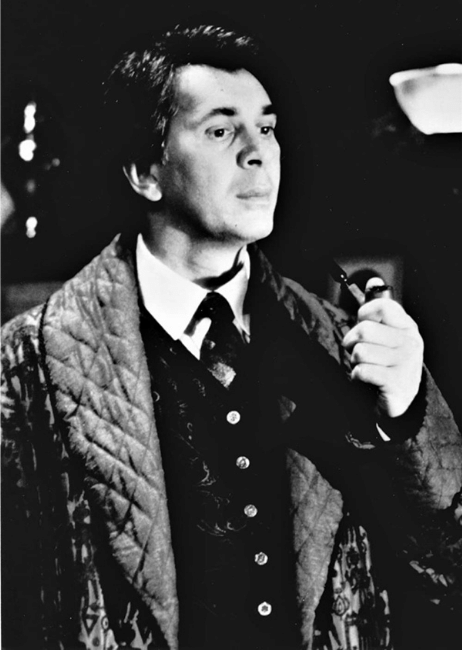
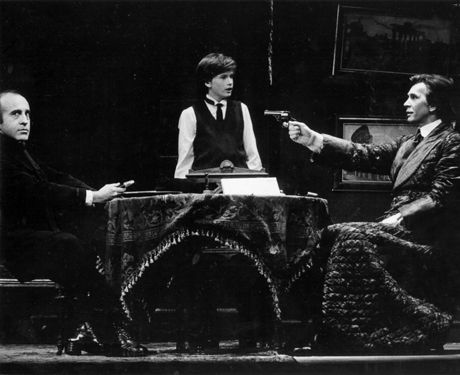
Frank Langella as the Great Sherlock Holmes on the Stage in 1981

Wednesday, June 1, 2016


Written for my Frank Langella Celebration! ❤

There are three types of Sherlockians in the world. If you don’t know what the word even means, then you’re clearly not one of them. Love you anyway!

You either a) are a Sherlock Holmes purist and only read the novels because no film adaptation has ever done the stories justice, b) don’t mind some changes to the concept so long as the general design of Sherlock Holmes remains intact, or c) are good with any and all adaptations and don’t care whether they match the books are not.

I, personally, fall into the 2nd category with occasional leanings either way depending on what it is I’m watching or reading.

My less forgiving Sherlock Holmes stance omits the idea of an older Holmes marrying a girl in her twenties like in Laurie R. King’s novels (despite liking the authoress as a person because she’s hilarious).

My more forgiving side is what we’re here to discuss right now.


Because Frank Langella (who I adore) played the great detective himself in a filmed theater production in 1981. It was based off a silent film from 1916 and even appears to use the same screenplay, although I’ve never seen the original so I can’t truly compare the two.

Having just recently watched The Twelve Chairs from 1970 with Frank (review coming later!), there is one scene in that movie which set him up as being a potentially brilliant Holmes. He’s masquerading as a communist worker in the bureau of chairs and tables and is so convincingly strict, so coldly calculating, so delightfully rude that it just screamed “cast me as Sherlock Holmes” to the world.

The world obviously listened.

Frank Langella embodies a perfectly entertaining version of Sherlock Holmes that has always and will always make me smile. I can even forgive his Holmes falling in love . . . because he does, and to the beautiful, young Alice Faulkner who wishes only to protect him. Yes, I find that funny since I’m certain Holmes can protect himself with very little effort. But there you have it, true love can be so very blind. So the romantic in me is indulgent of Holmes and Alice’s love, simply because it is Frank Langella and I can never get enough of him as a romantic lead. You’ll either love or hate this aspect of the play.


Romance aside, however, the mystery itself is a clever mashup of several of Holmes’ cases. I spotted elements of A Scandal in Bohemia and The Disappearance of Lady Frances Carfax, although I suspect there are more of the short stories incorporated into the plot. Holmes himself is both colder than normal and more yearning. He confesses to hopes and dreams that I’m sure the “real” Holmes never experienced. But his interaction with the feared Moriarty is fiendishly clever, and a goodly portion of the dialogue is played for laughs, which really works in a theater setting. You’re supposed to laugh when things are funny and so the staging of the lines ensures that you will.

The costuming is stunning as is the set-dressing. I fully believed I was watching scenes from actual Victorian, England, they were that good.

If you’re only accustomed to Frank in the movies, then you’re missing out. There are many nuances to stage acting that must be eradicated or toned down for film acting and so it’s intriguing to watch the stage version of Langella and discover just how very much of his acting style he had to change depending on whether he was on film or on the stage. It takes real talent to make an accomplishment of both venues.

Really, if you’re a diehard Langella fan, like me most of the time, then you’ll be forgiving of the little quips and quibbles in this play. Is it a faithful representation of Sherlock Holmes? No, it is idealized and humanizes him more than probably any other filmed version I’ve seen except for the steampunk movies of RDJ. But a little bit of humanizing never hurt anyone and I love to see Holmes revealing a softer side to Watson and to Alice, a side that many fans wish existed. This play isn’t for purists and that’s okay. It is, however, for Frank Langella fans, which is why I guiltily indulge in a viewing every couple of years or so, wishing that it was better film quality and dreaming that I will someday own an officially released DVD (not ever going to happen, I’m sure).

Should you care to try his charming version of Sherlock Holmes, visit the Youtube link below!

 
Read More